
How Smart Money Uses Liquidity to Engineer Market Moves.

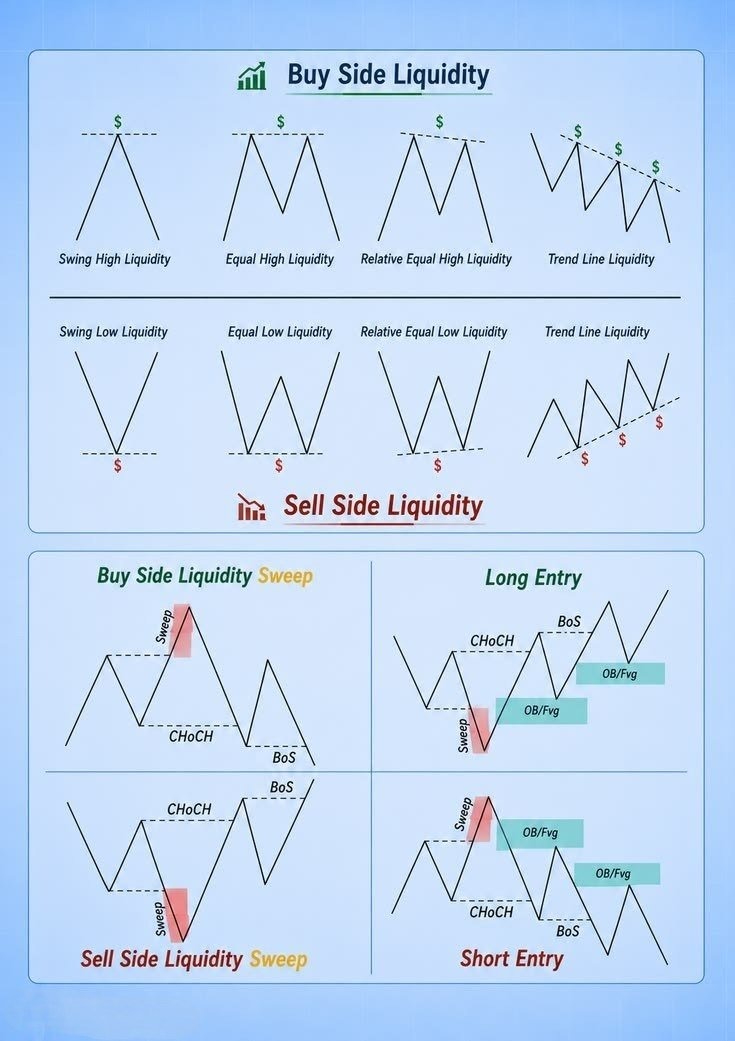
Stop Getting Trapped: How Smart Money Uses Liquidity to Engineer Market Moves
Most retail traders look at double tops, double bottoms, and trendlines as classic support and resistance.
Institutional algorithms view them as one thing: Liquidity pools.
If you want to trade alongside smart money rather than becoming their exit liquidity, you need to understand how liquidity sweeps and structural shifts work.
1. Identifying Liquidity Pools
Liquidity rests wherever retail stop-losses accumulate:
Buy Side Liquidity (BSL): Positioned above Swing Highs, Equal Highs (Double Tops), and descending trendlines.
Sell Side Liquidity (SSL): Positioned below Swing Lows, Equal Lows (Double Bottoms), and ascending trendlines.
2. The Manipulation: The Liquidity Sweep
Price rarely reverses without taking fuel first.
Smart money pushes price past a key high or low to trigger stop orders and breakout buyers/sellers.
Once orders are absorbed, the real directional move begins.
3. The Institutional Entry Blueprint
To enter safely after a sweep, follow this 4-step framework:
Sweep: Price takes out resting Buy-Side or Sell-Side liquidity.
CHoCH (Change of Character): Immediate structural break in the opposite direction on lower timeframes.
BoS (Break of Structure): Trend confirmation showing momentum expansion.
Entry on Retest (OB / FVG): Wait patiently for price to mitigate an Order Block (OB) or fill a Fair Value Gap (FVG) before executing.
The market moves from liquidity pool to liquidity pool. Stop trading the breakout; start trading the sweep.
