
India’s Q1 FY27 GDP: Is 8% Growth Really as Strong as It Looks?

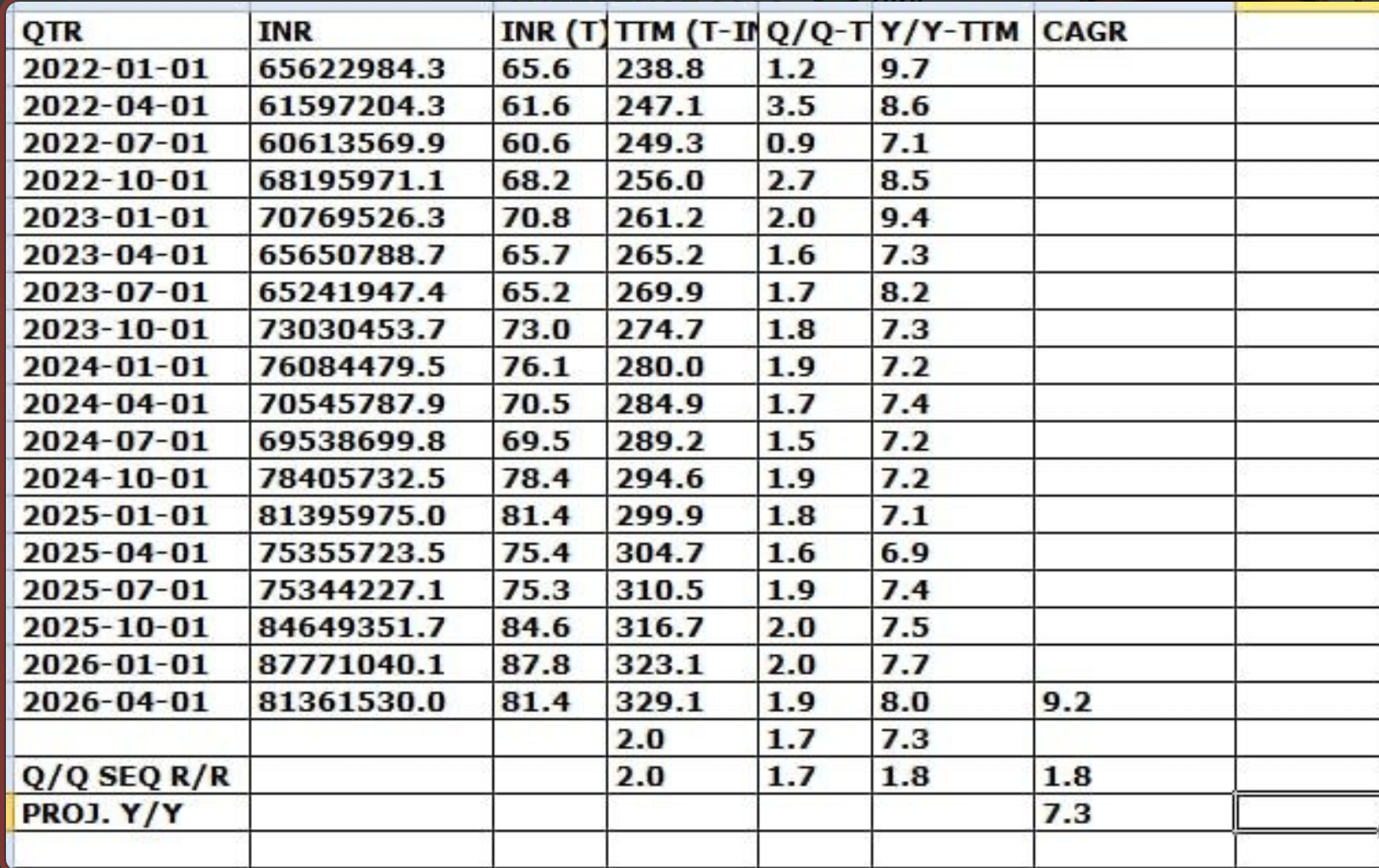
India’s Q1 FY27 Real GDP Growth: Strong Headline Growth, But Domestic Demand Remains a Concern .
Introduction
India's economy continues to show strong growth. According to the data provided, India's real GDP on a TTM (Trailing Twelve Months) basis reached ₹329.1 trillion in Q1 FY27, compared with ₹323.1 trillion in the previous quarter and ₹304.7 trillion a year earlier.
This means:
- Quarter-on-quarter (Q/Q) growth: 1.9%
- Year-on-year (Y/Y) growth: 8.0%
- Long-term trend/average growth: 7.3%
At first glance, this looks very positive because 8% growth is higher than the long-term 7.3% trend.
However, looking deeper into the numbers gives us a more interesting picture. The strong GDP growth appears to have received significant support from exports and a sharp fall in imports, while important domestic growth drivers such as private consumption and private-sector capital expenditure (CAPEX) remain relatively subdued.
1. GDP Growth Is Above the Long-Term Trend
The first positive signal is that India's real GDP growth has remained strong.
The data shows that TTM real GDP increased from:
₹304.7 trillion → ₹329.1 trillion
over the year.
That represents 8.0% Y/Y growth.
The long-term trend shown in the data is approximately 7.3%.
Therefore:
Current GDP growth of 8.0% is about 0.7 percentage points above the long-term trend of 7.3%.
This indicates that India's economy is currently expanding at a healthy pace.
In simple words:
India's economy is growing faster than its normal long-term pace.
That is clearly a positive sign.
2. But GDP Growth Needs to Be Looked at More Carefully
An 8% GDP growth number looks excellent, but GDP is not driven by only one factor.
Economic growth can come from different sources, including:
- Consumer spending
- Private investment
- Government spending
- Exports
- Imports
One important component is net exports, which means:
Exports − Imports
Therefore, if exports rise strongly while imports fall sharply, net exports can provide a significant boost to GDP growth.
This is important for understanding India's current growth picture.
3. Exports Have Been an Important Support
According to the data and analysis provided, India's exports have performed strongly.
The major contributors mentioned are:
IT and Services
India's IT and services sector continues to generate strong export earnings.
Petroleum Products
Petroleum and refined-product exports have also supported external trade.
Mobile and Electronics
India's mobile and electronics exports have become increasingly important.
Therefore, the export side of the economy is providing support to GDP growth.
In simple language:
India is earning more from selling goods and services to the rest of the world, and this is helping the economy grow.
4. Falling Imports Also Matter
Another important factor is the sharp decline in imports.
This is slightly complicated, so let's understand it simply.
GDP considers:
Exports positively and imports negatively.
Therefore, when imports fall significantly, the net export component can improve, even if the improvement is not necessarily coming from stronger domestic demand.
In the current situation, the data suggests that the decline in imports was partly related to the SOH (Strait of Hormuz) disruption/deadlock.
This means that some of the improvement in the GDP calculation may be coming from the external trade balance, rather than from very strong domestic economic activity.
5. The Biggest Concern: Domestic Demand
This is where the analysis becomes more important.
India's economy has two major private-sector domestic engines:
Private Consumption
This means spending by households and consumers.
Examples:
- Buying cars
- Buying smartphones
- Eating out
- Travelling
- Buying homes
- Purchasing consumer goods
When consumer spending increases strongly, businesses usually see stronger sales and may increase production and investment.
Private CAPEX
CAPEX means Capital Expenditure.
It is money companies spend on creating or expanding productive assets.
Examples:
- New factories
- Machinery
- Warehouses
- Data centres
- Manufacturing plants
- Infrastructure
Strong private CAPEX usually indicates that companies are confident about future demand.
6. Why Is This Important?
The data suggests that private consumption and private CAPEX remain subdued.
In simple words:
Indian consumers are not spending as aggressively as we would ideally like to see, and private companies are not investing as aggressively either.
This creates an interesting situation:
Headline GDP growth
8.0% → Strong
Exports
Strong → Positive
Imports
Sharp decline → Supports net exports
Private consumption
Subdued → Concern
Private CAPEX
Subdued → Concern
So, while the headline GDP number is impressive, the quality and sustainability of the growth deserve closer attention.
7. What Does This Mean for Investors?
For investors, simply looking at the headline GDP growth rate is not enough.
An investor should ask:
"What is actually driving the 8% growth?"
If growth is increasingly driven by:
Exports + temporary trade effects
then the sustainability of that growth could be different from growth driven by:
Consumer spending + private investment.
The second combination is generally more encouraging because it indicates that the domestic economy itself is becoming stronger.
8. What Should We Watch Going Forward?
For the next few quarters, investors should closely monitor:
1. Private Consumption
Is household spending accelerating?
2. Private CAPEX
Are Indian companies increasing investment?
3. Export Growth
Can IT, services, electronics and other exports continue growing strongly?
4. Import Growth
Does the decline in imports continue, or does it reverse as domestic demand improves?
5. Corporate Earnings
Are companies converting economic growth into higher revenues and profits?
6. Employment and Income
Are stronger GDP numbers translating into better incomes and employment?
These factors will help determine whether India's growth is broad-based and sustainable.
Conclusion
India's Q1 FY27 real GDP growth of 8.0% is clearly a positive headline number and is above the 7.3% long-term trend shown in the data.
However, the deeper picture is more mixed.
Strong exports and a sharp decline in imports have provided important support to growth. At the same time, private consumption and private CAPEX remain relatively subdued.
Therefore, the key issue is not simply:
"Is India growing at 8%?"
The more important question is:
"How much of this 8% growth is coming from strong domestic demand, and how much is coming from external trade and lower imports?"
If private consumption and private CAPEX begin to accelerate along with exports, India's growth could become broader, more balanced and more sustainable.
For investors, therefore, 8% GDP growth is encouraging—but the composition of that growth matters more than the headline number alone.