
FII Inflows November 2026: Why Foreign Investors Are Back

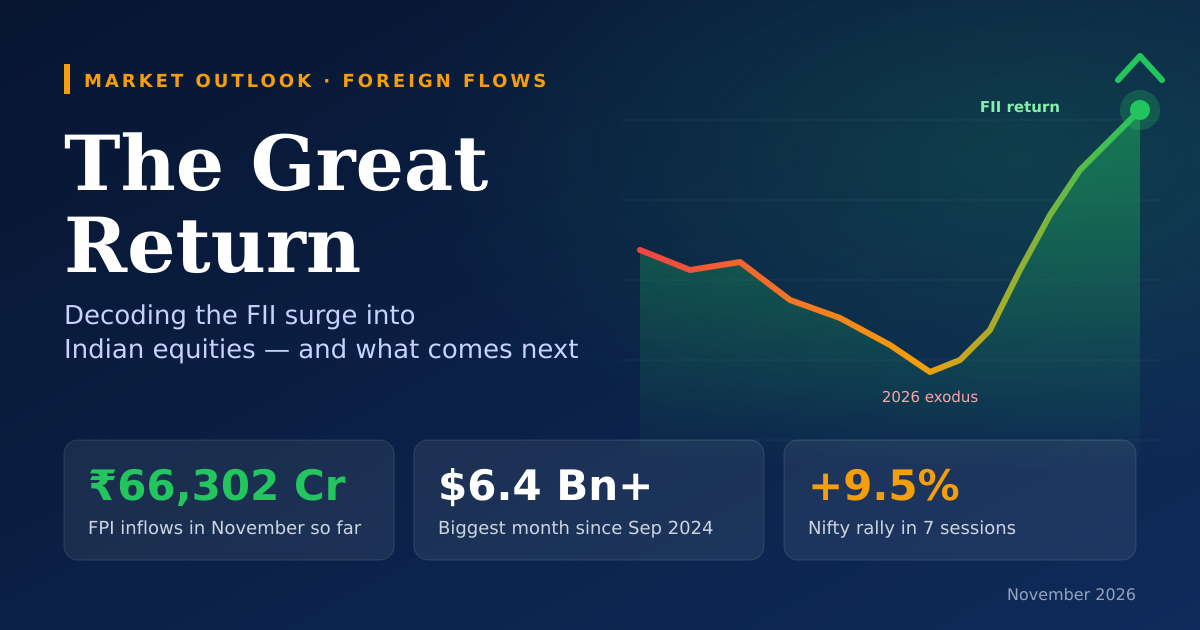
MARKET OUTLOOK | FOREIGN FLOWS
The Great Return: Decoding the FII Surge Into Indian Equities
After a year of record selling, foreign money is pouring back at a pace not seen in over two years. Is this the start of a new cycle, or a violent short-covering rally? A complete guide for investors.
November 12, 2026
For most of 2026, the story of Indian equities was a story of foreign investors leaving. They sold through the oil shock, through the rupee's slide past 90, and through a global AI frenzy that pulled capital toward Seoul and Taipei. Domestic investors carried the market on their backs. Then, in the space of three weeks, the script flipped.
Foreign portfolio investors (FPIs) have put roughly ₹66,300 crore into Indian equities in the first seven sessions of November, including ₹12,563 crore on November 11 alone. In dollar terms that is more than $6.4 billion, the strongest monthly foreign buying since September 2024, and November is not even half done. The Nifty 50 has rallied about 9.5% this month, closing at 25,255 on Wednesday, its highest level in nearly nine months. The Sensex has added roughly 8,000 points in eight sessions.
The week ended November 6 delivered the Nifty's best weekly gain since February 2021, up 8.6%, with 46 of 50 index stocks finishing higher. On November 5, FIIs bought ₹14,975 crore in the cash market, the largest single-day purchase in over a year. By that Friday, the buying streak had stretched to 14 consecutive sessions.
This piece breaks down where the selling came from, why it reversed, where the money is going, what the domestic institutions are doing on the other side of the trade, and, most importantly, what it means for your portfolio from here.
1. The Numbers at a Glance
| Metric | Figure | Period / Note |
| FPI net buying, November (NSDL) | ₹66,302 crore | Nov 2–11 |
| FII net buying, Oct 16–Nov 6 (exchange data) | ₹53,154 crore | Three-week reversal |
| FII buying, week ended Nov 6 (exchange) | ₹45,960 crore | NSDL shows ₹38,971 cr |
| Largest single-day FII buy | ₹14,975 crore | Nov 5; biggest in 1+ year |
| DII net selling, week ended Nov 6 | ₹24,197 crore | Ended 11-week buying run |
| FPI net selling, October (CDSL) | ₹34,843 crore | Second straight month |
| FPI net selling, September | ₹35,861 crore | Start of the latest exodus |
| Nifty 50 move, November to date | ~ +9.5% | Close 25,255 on Nov 11 |
| Brent crude | ~ $92/bbl | Fell 16% in week to Nov 6 |
| USD/INR | ~ 93.7–93.8 | Recovering with crude |
A note on the data: exchange-reported FII figures (provisional cash-market) and NSDL's custodian-settled FPI figures routinely differ, sometimes by thousands of crore in a week, because NSDL also captures primary-market allotments and settles with a lag. Both tell the same story; quote whichever you track consistently.
2. How We Got Here: The Year of the Great Exodus
To understand the force of this reversal, you have to appreciate how deep the hole was. Before November, cumulative FPI outflows from Indian equities in 2026 stood at somewhere between ₹2.4 lakh crore and ₹2.95 lakh crore depending on the data source, comfortably above the ₹1.66 lakh crore pulled out in all of 2025. Foreign ownership of Indian equities had already sunk to a 14-year low on Goldman Sachs' reckoning earlier in the year.
Four forces drove that selling:
• The energy shock. The US-Iran conflict and supply risks around the Strait of Hormuz kept crude elevated for months. For a country that imports most of its oil, high crude means a wider current account deficit, imported inflation and a weaker currency, all of which foreign investors price in immediately.
• A weak rupee. With the rupee drifting into the 93–94 range, a foreign investor's dollar returns from Indian stocks were being eroded even when local indices held up.
• Punishing US yields. The US 10-year Treasury yield closed above 5% in late October. When risk-free dollar assets pay that much, the hurdle rate for emerging-market equities rises sharply.
• The AI magnet. Global funds chased AI-hardware winners in South Korea and Taiwan, where the KOSPI nearly doubled in the first half of 2026. India, with no meaningful listed chip or AI-hardware champion, was a funding source for that trade. Analysts estimated much of India's 2026 outflow found its way into Samsung, SK Hynix and TSMC.
The selling peaked in the first half of October, when FPIs dumped nearly ₹48,000 crore in a single fortnight. What prevented a crash was the domestic bid. Domestic institutional investors have crossed ₹5 lakh crore of net equity buying for the third consecutive calendar year, and SIP inflows hit a record ₹32,490 crore in September. That domestic wall is a crucial part of this story, and we will return to it.
3. Why the Tide Turned
No single trigger explains a reversal of this size. It is the convergence of several forces, each of which had been building quietly.
Trigger 1: The crude collapse
This is the most immediate catalyst. Brent fell more than 16% in the week to November 6, touching about $93 a barrel, and has since drifted towards $92. For India, cheaper oil is the single most powerful macro tonic available: it narrows the import bill, relieves pressure on the rupee, and cools inflation expectations. The rupee has already firmed towards 93.7. Every dollar off crude improves the arithmetic of owning Indian assets in dollar terms.
Trigger 2: The AI trade cracks, and India becomes the hedge
The same AI-concentration that drained India for most of the year is now working in reverse. A sell-off in global AI and semiconductor names, led by Nvidia and the Korean and Taiwanese chipmakers, has forced funds to reassess concentrated exposure. India's relative lack of AI-hardware exposure, a weakness for eleven months, is suddenly a feature. For an emerging-markets manager looking to cut AI beta without leaving EM altogether, India is the largest, most liquid destination available.
Trigger 3: Positioning had become extreme
When the most crowded trade is being underweight a market, it does not take much good news to force a scramble. Global funds entered the fourth quarter with India allocations at multi-year lows. The speed of the buying, with ₹28,725 crore in just two sessions on November 5 and 6, has the fingerprints of underweight managers and systematic, model-driven funds chasing a breakout rather than a slow, deliberate accumulation.
Trigger 4: Large-cap valuations had reset
Months of selling did their job on valuations. The Nifty 50 was trading near 19 times earnings at the start of November, a meaningful discount to its own recent history and a much narrower premium to other emerging markets. Crucially, mid and small caps remain far more expensive, which explains why the foreign money has gone overwhelmingly into the benchmark heavyweights.
Trigger 5: Earnings delivered
The July–September quarter results season has broadly reassured. Median profit growth across the 558 companies that had reported by early November was around 21% year-on-year. Banks, NBFCs and automobile majors in particular posted numbers strong enough to justify a re-rating, giving foreign buyers a fundamental anchor rather than a purely tactical one.
4. Where the Foreign Money Is Going
Sector-wise NSDL data for November will only be published in the coming days, but two pieces of evidence are already clear.
First, the late-October rotation was narrow. In the October 16–31 fortnight, FPIs bought ₹13,112 crore of equities, but only 5 of 24 sectors saw net inflows. IT (₹10,915 crore) and telecom (₹11,065 crore) together absorbed nearly ₹22,000 crore, while financial services, FMCG and autos continued to see selling. IT buying in particular reflected money exiting AI hardware abroad and seeking lower-risk technology exposure in Indian services names.
Second, November's price action shows the bid broadening to financials and cyclicals. Leaders in the week to November 6 were Shriram Finance (+16.8%), Bajaj Finance (+15.8%), Mahindra & Mahindra (+15.7%), HDFC Bank (+13.8%) and Reliance Industries (+13.3%). Notably, Infosys and TCS were among the few Nifty laggards that week, suggesting the late-October IT trade has already been partly absorbed and the new money is flowing into the highest-weight, most liquid financials and cyclicals.
Oil-sensitive sectors are the other obvious beneficiaries of the crude slide: oil marketing companies, paints, aviation, tyres and chemicals, where input costs move directly with crude, have all caught a bid.
| Theme | Why foreign money likes it | What to watch |
| Large private banks & NBFCs | Highest index weight, strong Q2, heavy FPI underweight after ₹1 lakh cr+ of 2026 selling | Credit costs, deposit growth |
| Autos & capital goods | Earnings momentum, domestic demand visibility | Monthly volumes, order inflows |
| IT services | Lower-risk tech exposure as AI hardware sells off | US demand, deal pipelines |
| Telecom | Pricing power, cash-flow visibility | Tariff actions |
| Oil beneficiaries | Direct margin tailwind from falling crude | Brent sustainability below $95 |
5. The Other Side of the Trade: Domestic Institutions Take Profits
Every buyer needs a seller, and in November the seller has been the domestic institution. DIIs sold ₹24,197 crore in the week to November 6, snapping an 11-week buying streak, including ₹10,445 crore on November 5 alone. This is not a sign of domestic pessimism. Mutual funds and insurers had been buying aggressively through the sell-off at much lower levels; selling into a foreign-driven spike is textbook portfolio management. Several large funds had also been running elevated cash levels and have been redeploying selectively.
The important point for investors is this: the structural domestic bid has not gone anywhere. Monthly SIP flows above ₹32,000 crore mean that any meaningful correction is likely to be met by domestic buying again. In past cycles, a foreign exodus meant a market crash. In 2026, it meant a market that went sideways. That shock absorber is now the floor beneath this rally, and it is the single biggest reason a foreign return could prove more durable than in earlier cycles.
The market has rarely enjoyed simultaneous foreign and domestic buying. If both engines fire together, that is the combination that powers the next leg of a bull market. For now, they are trading against each other.
6. Tactical Bounce or Structural Return? The Honest Answer
The strongest analysis is a two-sided one. Here is how we weigh it.
The bull case
• Positioning remains light. Even after ₹66,000 crore of buying, November recovers only a fraction of 2026's ₹2.4–3 lakh crore outflow. There is plenty of room for underweight funds to keep rebuilding.
• India's macro improves sharply if crude stays near $90. A firmer rupee then becomes self-reinforcing: currency gains add to dollar returns, which attract more flows.
• Earnings are turning. A broad-based Q2 beat, especially in financials, provides the fundamental support that was missing in previous false dawns.
• The AI rotation is a structural, not one-week, theme. If global investors keep trimming concentrated AI-hardware bets, India is a natural, diversified destination.
The bear case
• The Fed is hawkish, not dovish. The Fed held rates in October with two dissents in favour of a hike, and markets were pricing roughly 85% odds of a December rate increase. US 10-year yields near 5% remain a heavy headwind for every emerging market. A hawkish December could abruptly reverse EM flows.
• Crude is a geopolitical coin-toss. The US-Iran conflict is unresolved and Hormuz tensions persist. A renewed spike back above $100 would undercut the entire thesis within days.
• The AI trade can snap back. If chip stocks rebound sharply, the 'India as anti-AI hedge' trade could unwind just as quickly as it arrived.
• The flow is fast money. Flows driven by short-covering and model-based allocation are, by nature, quick to reverse. Analysts have consistently cautioned that selective, tactical buying should not be mistaken for a broad foreign comeback.
• Supply is waiting. A heavy IPO and block-deal pipeline tends to absorb foreign appetite in rallies. FPIs put ₹12,902 crore into primary markets in October alone.
Our view: the surge is real, but its first phase is tactical. It was triggered by crude, positioning and the AI unwind, not yet by a fundamental re-rating of India by long-only global allocators. For it to become structural, we need three things to hold through the next two to three months: Brent sustainably below $95, the rupee stable or firming, and Q3 earnings confirming the Q2 recovery. If those boxes are ticked, December–March could see the long-only money follow the fast money, which is the phase that typically produces durable market highs.
7. What to Watch: The Investor's Checklist
| Indicator | Supportive signal | Warning signal |
| Brent crude | Holds below $95; drifts to $85–90 | Back above $100 on Hormuz news |
| USD/INR | Firm below 94; trending to 92–93 | Fresh lows past 94.5 |
| US Fed (December) | Hold or dovish tone; 10Y below 5% | Rate hike with hawkish guidance |
| Daily FII flows | Buying continues on down days | Streak breaks with large selling |
| NSDL sector data | Buying broadens beyond 5–6 sectors | Flows stay narrow and concentrated |
| Korea / Taiwan | AI names keep consolidating | Sharp chip rebound pulls money back |
| DII flows | Buying resumes on dips | Sustained heavy DII selling |
| Q3 FY27 earnings | Financials and autos sustain growth | Downgrades return |
8. Portfolio Strategy: How to Position
• Respect the leadership, do not chase it. Foreign money is concentrated in large caps. After a 9–10% move in seven sessions, fresh deployment is best staggered over the coming weeks rather than made in one go at the top of a near-vertical move.
• Tilt towards large caps. With the Nifty near 19 times earnings and broader markets more expensive, the risk-reward favours quality large caps, particularly well-capitalised private banks, leading NBFCs and domestic-demand cyclicals.
• Use crude as your compass. Oil beneficiaries offer the most direct exposure to the current macro tailwind, but size them as a tactical position, not a core holding, given geopolitical risk.
• Be selective in mid and small caps. These segments have not been the destination for foreign money and remain richly valued. Favour names with clear earnings visibility over broad exposure.
• Keep SIPs running. The domestic flow engine is the market's floor. Long-term investors should continue disciplined investing regardless of the day-to-day flow headlines.
• Keep dry powder. A hawkish December Fed or a crude spike could produce a sharp pullback. Holding some liquidity lets you buy that dip rather than fear it.
The Bottom Line
The return of foreign investors is the most significant shift in Indian market structure this year. After eleven months in which domestic savers single-handedly held the line, India now has a second engine coming back online. The surge was ignited by falling oil, a cracking global AI trade and extreme underweight positioning, and it has been validated, so far, by solid earnings.
But a surge is not yet a cycle. The next few weeks, with a pivotal Fed decision, volatile crude and fresh sector-flow data, will tell us whether this is the opening chapter of a multi-month foreign re-allocation to India or another sharp, flow-driven rally in a difficult year. The sensible stance is to participate with discipline: own quality, stagger entries, watch crude and the rupee closely, and let the data, not the euphoria, guide the next allocation.
Data sources: NSDL and CDSL FPI data, NSE/BSE provisional FII-DII data, AMFI, and reporting by PTI, Business Standard, Kotak Neo, Angel One, The Week and others, as of November 12, 2026. Flow figures are provisional and subject to revision.
Disclaimer: This article is for informational and educational purposes only and does not constitute investment advice or a recommendation to buy or sell any security. Investments in securities markets are subject to market risks. Please read all related documents carefully and consult your advisor before investing.
FII Surge Outlook | Page