
Is India VIX: A Powerful Risk Assessment Tool for Investors and Traders?

By Ankur Sharda
Introduction
Most investors focus on one question before entering the stock market:
Will the market go up or down?
But there is another equally important question:
How risky or volatile is the market environment likely to be?
This is where India VIX becomes useful.
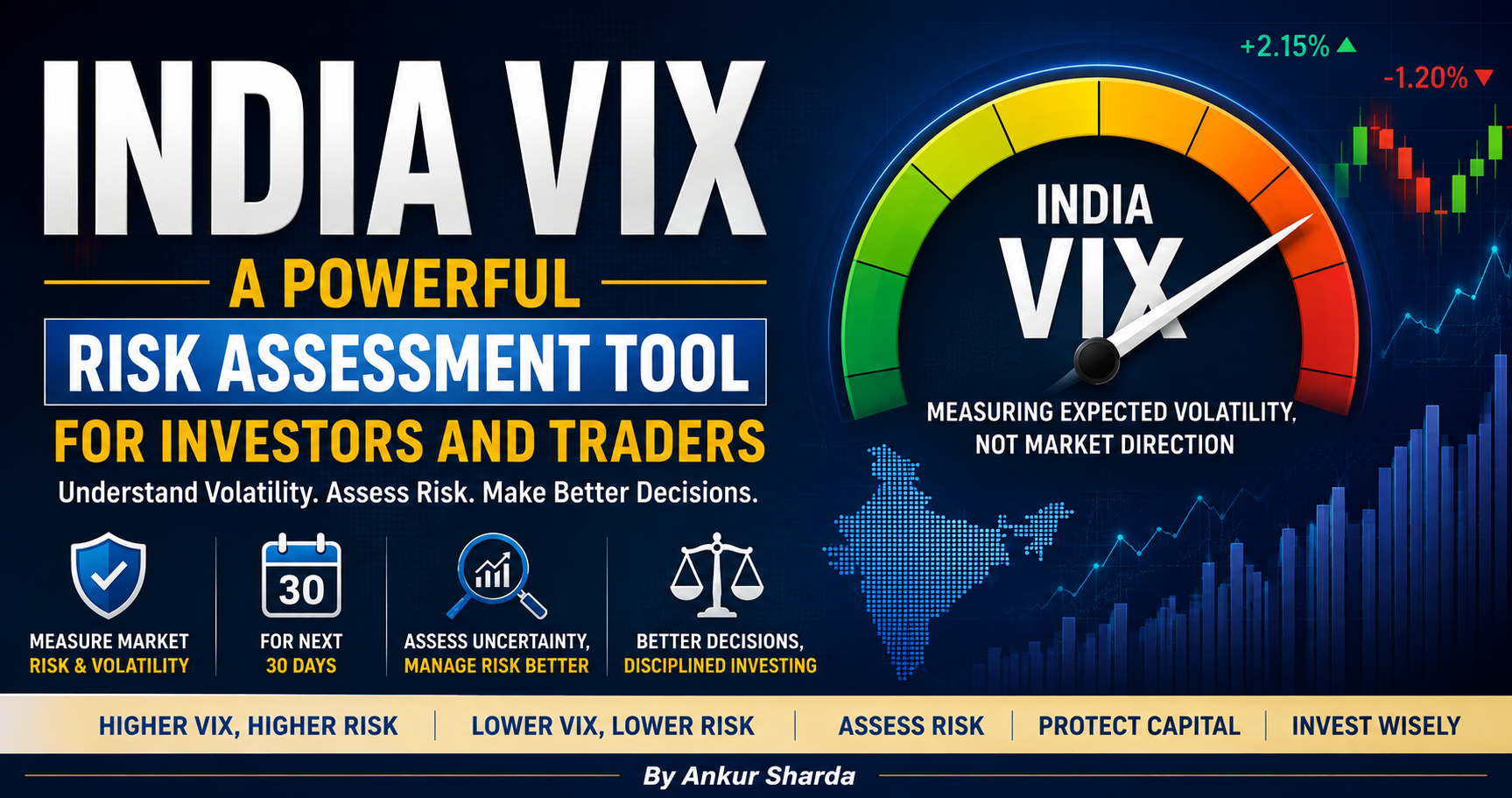
India VIX, or India Volatility Index, measures the market’s expectation of volatility in the Nifty over the next 30 calendar days. It is calculated from the prices of Nifty index options and expressed as an annualised percentage.
India VIX is often called the “Fear Index.” However, that description is incomplete.
A better way to understand India VIX is as a Market Risk Assessment (RA) Tool.
It does not predict whether the Nifty will rise or fall. Instead, it provides an estimate of the level of uncertainty and the magnitude of market movement that the options market is expecting.
The higher the India VIX, the greater the expected volatility. The lower the India VIX, the calmer the market is expected to be.
1. What is India VIX?
India VIX is a volatility index published by the National Stock Exchange.
It is calculated using the best bid and ask prices of out-of-the-money Nifty option contracts across relevant expiries. The calculation produces an estimate of expected volatility over the next 30 calendar days, expressed as an annualised percentage.
For example:
India VIX = 15
This does not mean that the Nifty will rise or fall by 15% next month.
It means the options market is pricing in approximately 15% annualised volatility.
To understand the expected movement over the next 30 days, the annualised figure must be converted into a shorter-period estimate.
2. India VIX Measures Risk, Not Direction
This is the most important principle.
A high India VIX does not mean the market will definitely fall.
A low India VIX does not mean the market will definitely rise.
India VIX measures the expected magnitude of price movement, not its direction.
The market could:
- rise sharply,
- fall sharply,
- or remain highly volatile in both directions.
Therefore, the correct interpretation is:
High VIX = High Expected Market Risk and Volatility
Low VIX = Lower Expected Market Risk and Volatility
This is why India VIX can be treated as a Risk Assessment Indicator.
NSE itself describes volatility as the rate and magnitude of price changes and notes that volatility in finance is often referred to as risk.
3. India VIX Levels as a Risk Assessment Framework
Instead of looking at India VIX as a buy or sell signal, investors can classify the market into different risk zones.
India VIX below 12: Low-Risk Volatility Environment
A low VIX generally indicates that the options market expects relatively limited movement.
Characteristics may include:
- Stable market conditions
- Lower uncertainty
- Smaller expected price swings
- Relatively cheaper option premiums
However, low volatility should not automatically be interpreted as a safe market.
Sometimes an extremely calm market can be vulnerable to a sudden increase in volatility when unexpected events occur.
Risk Assessment:
Low current volatility risk, but possible complacency risk.
India VIX between 12 and 18: Normal Volatility Environment
This can be considered a relatively balanced volatility environment.
The market expects movement, but uncertainty is not exceptionally high.
Risk Assessment:
Normal Market Risk
This environment may be more suitable for investors who want relatively predictable market conditions compared with periods of extreme volatility.
India VIX between 18 and 25: Elevated Risk Environment
A rise in India VIX indicates that the options market expects larger price movements.
Risk Assessment:
Elevated Market Risk
Investors may consider:
- Reducing excessive leverage
- Reviewing stop-loss positions
- Avoiding impulsive entries
- Maintaining higher cash reserves
- Hedging portfolios where appropriate
India VIX above 25: High-Risk Volatility Environment
A high VIX indicates substantial expected market movement.
Markets may become difficult to predict in the short term.
Price movements can become:
- Faster
- Larger
- Less predictable
- More sensitive to news
Risk Assessment:
High Market Risk
In such conditions, capital preservation and position sizing can become more important than aggressive return targets.
4. India VIX as a Risk Assessment Tool for Investors
An investor can use India VIX before making an investment decision.
Instead of asking only:
“Should I buy this stock?”
The investor can also ask:
“What is the current market risk environment?”
For example:
Low VIX
An investor may decide to deploy capital gradually and maintain normal position sizes.
Rising VIX
An investor may:
- reduce leverage,
- avoid oversized positions,
- diversify exposure,
- increase liquidity,
- or invest through staggered buying.
Extremely High VIX
An investor may focus more on:
- capital protection,
- position sizing,
- hedging.
India VIX should not replace fundamental analysis. Instead, it can act as a risk evaluation above the investment decision.
5. India VIX for Traders
India VIX can be particularly useful for traders because volatility directly affects:
- option premiums,
- stop-loss requirements,
- position sizing,
- expected movement.
When India VIX rises, option premiums generally reflect higher expected volatility. A trader using the same position size in a low-VIX and high-VIX environment may actually be taking different levels of risk.
Position Size → Stop Loss → Target → Risk per Trade
The goal is not to predict the next move. The goal is to understand the current risk environment.
6. India VIX and Position Sizing
This is where India VIX can become a practical risk management tool.
Suppose an investor normally invests ₹1,00,000 in a position during a normal volatility environment. If market volatility doubles, the investor may decide that investing the same amount creates excessive risk.
The investor could therefore:
- reduce position size,
- invest in stages,
- diversify more,
- or maintain additional cash.
The exact reduction cannot be determined by India VIX alone.
But India VIX can act as a warning signal:
Higher Volatility → Reassess Position Size
This is the central principle of risk management.
7. Why India VIX Should Not Be Used Alone
India VIX is a tool, but it has limitations.
It does not tell us:
- whether Nifty will rise or fall,
- which individual stock will outperform,
- whether the expected volatility will definitely occur,
- the exact timing of market movement,
- or the exact top and bottom of the market.
India VIX should therefore be combined with:
For Investors
- Fundamental analysis
- Asset allocation
- Diversification
- Valuation
- Debt and equity exposure
For Traders
- Price action
- Trend analysis
- Support and resistance
- Risk-reward ratio
8. India VIX vs Market Direction
Example:
Nifty is rising strongly.
At the same time:
India VIX is also rising.
This does not necessarily mean that the market will immediately fall. It may simply mean that the market expects large movement and uncertainty.
Similarly:
Nifty may fall while VIX remains relatively stable.
The relationship is not a guaranteed one-to-one signal. Therefore, investors should avoid this mistake:
“VIX is rising, so I must sell the market.”
The better interpretation is:
“VIX is rising, so market risk and expected volatility are increasing. I should reassess my exposure.”
This distinction separates prediction from risk management.
9. Conclusion: India VIX is a Risk Meter, Not a Gauge
India VIX is one of the most useful indicators for understanding the risk environment of the Indian stock market. It does not tell us where the market will go. It tells us how much movement the options market expects.
That makes India VIX valuable for:
- estimating expected market movement,
- understanding market uncertainty,
- assessing portfolio risk,
- adjusting position size,
- evaluating trading conditions,
- and improving risk management.
The best way to understand India VIX is Nifty tells you the current level of the market. Therefore, India VIX should not be treated as a simple fear indicator or a buy-sell signal. It should be treated as a Market Risk Assessment Tool.
India VIX is better understood as a Market Risk Assessment Index than merely a Fear Index. VIX is commonly nicknamed the "Fear Gauge" or "Fear Index" in financial media, borrowed from the original CBOE VIX terminology. It's called that because it tends to spike when markets sell off or uncertainty rises, reflecting panic/hedging demand for options.
Because the word fear creates an impression that a high VIX means the market will fall. In reality, a high VIX indicates that the market expects larger price movement in either direction.
Disclaimer:
This article is for educational and informational purposes only and does not constitute investment advice or a recommendation to buy or sell any security.
Ankur Sharda
SEBI Registered Research Analyst
SEBI Reg. No.: INH000028839
Website: www.ankursharda.in
https://www.youtube.com/@Anksvodcast
Investments in securities are subject to market risks.