
Manipal Health IPO Review: Skip the Listing, Buy the Dips?

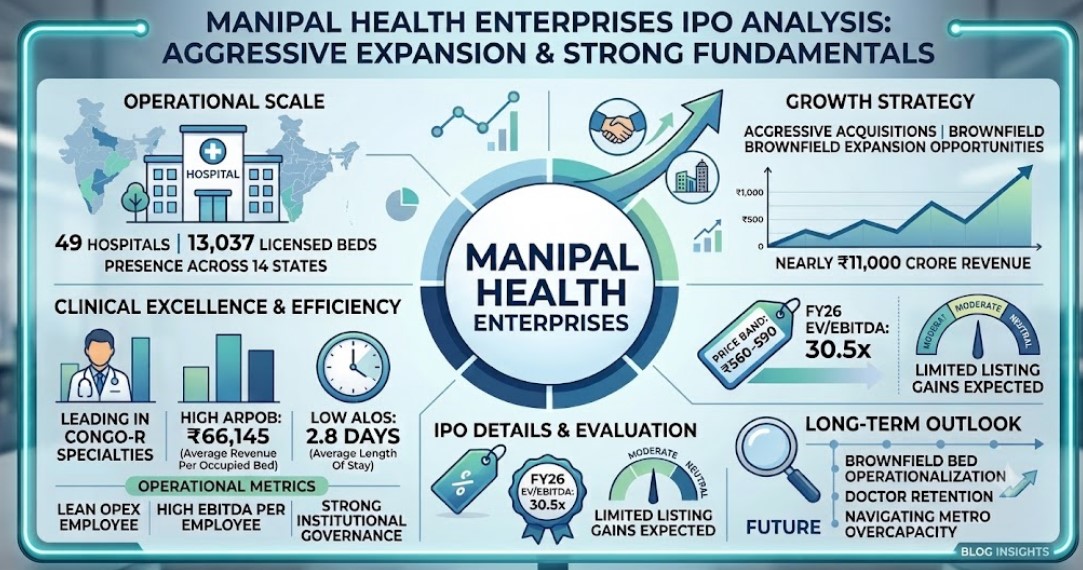
Manipal Health Enterprises Ltd is among India’s largest private hospital networks, operating 49 hospitals with over 6,900 beds (13,000 licensed beds) across 14 states and 19 cities. Backed by Temasek Holdings Pte Ltd, the founding Manipal family, and TPG Inc, the company is distinguished by its professionally managed, board-led governance model.
Over the past five years, Manipal has evolved from a predominantly South India-focused operator into a leading pan-India healthcare platform through a combination of strategic acquisitions and capacity expansion. The company maintains a strong focus on tertiary and quaternary care, with centres of excellence across key specialties. At the same time, its “branded house” strategy has enabled seamless integration of acquired assets under the Manipal brand. On a pro forma basis, including the recent Sahyadri acquisition, the business generates an annual revenue run rate of nearly INR 11,000 crore.
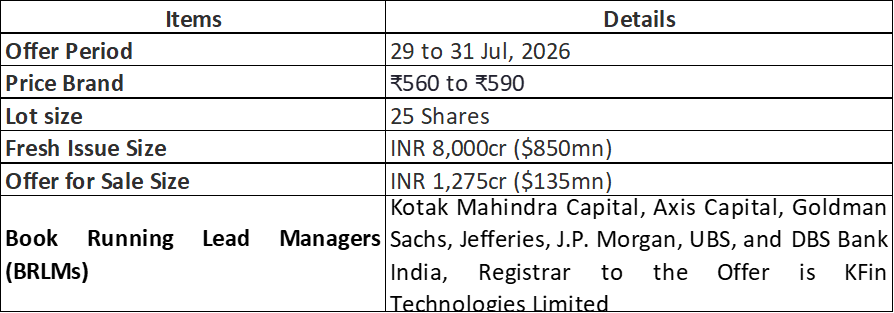
IPO Details:
The IPO is open already, will start with a Top-down peer comparison, followed by other key insights about the company.
Thoughts on the issue:
We believe the IPO has been priced appropriately (in line with peers), leaving limited scope for any listing pop. The optionality around brownfield expansion is significant, and strong execution could help the stock re-rate to the top of the pack. We recommend that short-term investors to skip the IPO and that long-term investors add on dips.
Key Risks & concerns:
Too much Capital is chasing the healthcare industry today:
The post-COVID world has seen a massive influx of Capital chasing the hospital industry in India. The macro theme of rising healthcare demand amid low per-capita bed capacity has attracted global capital to India. We have seen a marked increase in the number of organised beds in India. As per reports, ~1 lakh of the 3.5 lakh operational beds are organised in India, with listed players accounting for 40-45%. Notably, this number has doubled in the last 5 years and is set to double again in the next 4 years as listed players aggressively expand into Tier-1 cities using both organic and inorganic expansions. Temasek-backed Manipal faces stiff competition from KKR-led HCG Global, TPG-led Asian hospitals, and General Atlantic-led Ujala Cygnus. Earlier this month, Blackstone completed the acquisition of Aster DM.
The risk of overcapacity in Tier-1 metros is real in specific premium micro-markets, like Gurugram in NCR or parts of South Bengaluru. When you have three or four major hospital chains building 500-bed facilities within a 10-kilometer radius, you get a dilution of occupancy and intense poaching of clinical talent.
Integration challenges amid entry into new markets:
Indian markets have deep variances across sub-regions, which have led to inefficient, fragmented markets. Manipal also has struggled with its acquisitions in Kolkata, where management cites operating metrics remain weak even after 24 months post acquisition. The most prominent concern around integration is doctor remuneration. Hospital operators in the South usually work on an on-roll model, while those in the other regions typically work on a consultant model with heavy minimum guarantees and other perks offered to doctors. The retention of star doctors in such setups has multiple challenges.
Business Overview:
Manipal Health Enterprises has its origins in the Manipal Group, founded by Dr. T. M. A. Pai, a pioneer in India’s private healthcare and education sectors. The company’s healthcare operations began with the launch of its flagship Manipal Hospital on Old Airport Road in Bengaluru in 1991. Manipal Health Enterprises was formally incorporated in February 2010 and subsequently converted into a public limited company in December 2025, reflecting its evolution into one of India’s leading private healthcare providers.
Manipal Health Enterprises Ltd operates a pan-India network of multispecialty hospitals delivering a comprehensive range of care services, from outpatient services to complex tertiary and quaternary interventions. As of March 31, 2026, it operated 49 hospitals with 13,037 licensed beds across 14 states and union territories and had the widest hospital footprint among private hospital chains in India. It has the largest multispecialty hospital network by bed capacity and the second-largest hospital chain by number of hospitals in India.

Its multi-hospital presence enables delivery of care closer to patients’ homes for critical interventions and serves broad referral areas. With its focus on improving healthcare access, the company maintains a balanced presence across metros and non-metros, with 46.78% of beds located in metros and 53.22% in non-metros as of March 31, 2026. The company served 7.63 million patients across its network (including O&M hospitals) in Fiscal 2026.

Core Clinical Specialties (CONGO-R)
The hospital network focuses heavily on high-acuity, complex procedures across six primary specialties, collectively referred to as CONGO-R:
- Cardiac Sciences: Services span preventive care, interventional cardiology, electrophysiology, and structural heart therapies. Procedures include complex coronary interventions, transcatheter aortic valve replacements, minimally invasive cardiac surgeries, and heart transplantations.
- Oncology: The network provides medical, surgical, and radiation oncology, supported by precision-oncology tools like next-generation sequencing (NGS). Treatments include stereotactic radiation, robotic oncologic surgeries, bone marrow transplantations, and advanced CAR-T cell therapy.
- Neurosciences: Services include 24/7 stroke care, neuro-interventional procedures (such as mechanical thrombectomies), and complex cranial and spine surgeries. They also offer a comprehensive epilepsy surgery program and neuromodulation procedures like deep brain stimulation.
- Gastro Sciences: Offers medical and surgical gastroenterology, including hepatopancreatobiliary services. Procedures include advanced endoscopies (ERCP, EUS, POEM), robotic gastrointestinal surgeries, and both adult and pediatric liver transplants.
- Orthopaedics: Spans trauma care, sports medicine, pediatric orthopedics, and joint replacements. Their capabilities include robotic-assisted knee and hip arthroplasty, deformity correction, and complex spine surgeries.
- Renal Sciences: Comprehensive kidney care covering nephrology and urology. Services include hemodialysis, peritoneal dialysis, endourology for stone diseases, prostate therapies, and high-risk kidney transplantations.
Other Clinical Specialties and Specialized Centres
In addition to the CONGO-R specialties, Manipal Hospitals provides care in internal medicine, general surgery, obstetrics and gynecology, pediatrics, critical care, pulmonology, ears, nose and throat (ENT), rheumatology, and plastic and cosmetic surgery. The network also operates specialized interdisciplinary facilities, such as the Children’s Airway and Swallowing Centre, which manages complex airway, voice, feeding, and swallowing disorders in children.
| Clinical Specialty | Fiscal 2026 (Pro Forma) | Fiscal 2026 (Actuals) | Fiscal 2025 (Actuals) | Fiscal 2024 (Actuals) |
| Cardiac Sciences | 16.76% | 16.27% | 15.74% | 15.24% |
| Orthopaedics | 12.64% | 12.87% | 12.52% | 12.93% |
| Oncology | 11.37% | 11.60% | 10.24% | 8.87% |
| Neurosciences | 9.14% | 9.07% | 9.15% | 9.12% |
| Renal Sciences | 7.18% | 7.34% | 7.55% | 7.76% |
| Gastro Sciences | 7.00% | 7.15% | 7.36% | 7.63% |
| Total CONGO-R Contribution | 64.09% | 64.30% | 62.56% | 61.55% |
| Others | 35.91% | 35.70% | 37.44% | 38.45% |
Aggressive Inorganic Expansion Strategy
Manipal Health Enterprises has evolved from a regional Bengaluru-based hospital operator into one of India’s largest healthcare platforms through a disciplined combination of organic expansion and strategic acquisitions. Over the past five years, the company has acquired 31 hospitals across five major transactions Columbia Asia, Vikram, AMRI, Medica Synergie, and Sahyadri Hospitals taking its pro forma annual revenue run rate to nearly ₹11,000 crore.
The company has established a differentiated position as a healthcare consolidator, with a proven track record of integrating acquired assets through standardised clinical protocols and operational best practices, driving improvements in efficiency, quality of care, and profitability.

Future expansion:
The Indian market remains underpenetrated on a per-capita basis for hospitals and doctors. This is a well-documented and often repeated fact, and hence, we will not repeat the details here. As for MHEL, it plans to expand its network and footprint through both brownfield and greenfield projects. It seeks to maintain and strengthen its leadership in its key regions of Karnataka, Maharashtra and Goa, and eastern India (particularly West Bengal), while increasing its presence in regions such as Delhi NCR, central India, and eastern India (particularly Ranchi, Jharkhand, and Bhubaneswar, Odisha). In parallel, it aims to continue enhancing clinical case mix by increasing the share of high‑end and complex procedures within its CONGO-R specialties.
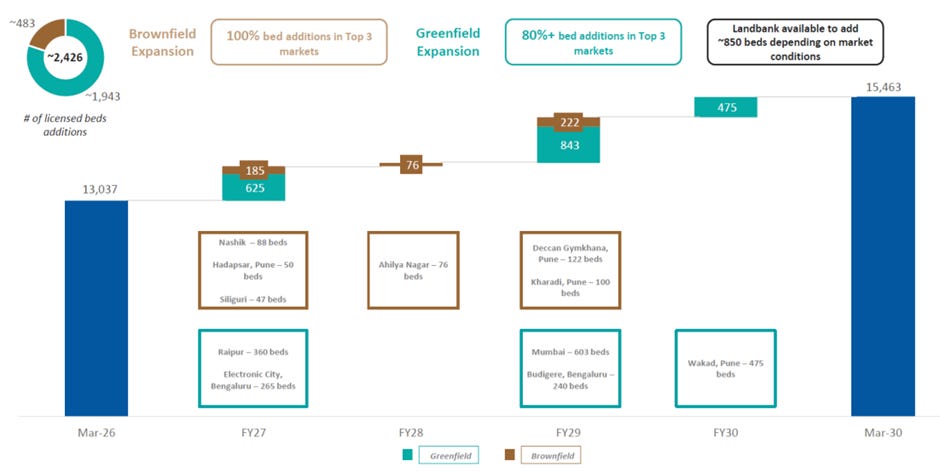
Through its brownfield expansion plans, it expects to add approximately 751 licensed beds across existing hospitals by 2030. It plans to add approximately 1,943 licensed beds through greenfield projects by 2030; see the company-provided snippet on its expansion plans.
This article provides a concise summary of my views on the Manipal Health IPO. For a comprehensive analysis covering the company’s business model, industry outlook, financial performance, valuation, key risks, and investment thesis, I invite you to read my full research report on Smartkarma.
Read the detailed report using the link attached below.
Manipal Health IPO: Skip the Listing, Buy the Dips?. Read more: https://skr.ma/Wmher
Disclaimer:
Himanshu Dugar is a SEBI-registered research analyst (No. INH200009944). BSE Enlistment No. 5593
Content shared on this handle is for informational and educational purposes only and does not constitute personalized investment advice, recommendations, or solicitation to buy or sell any security. Investments in securities markets are subject to market risks. Please read all related documents carefully before investing.
Full statutory disclosures: stylusholdings.com/disclosures/