
India’s Aero-Engine Value Chain: The Indian Companies Behind the Engine

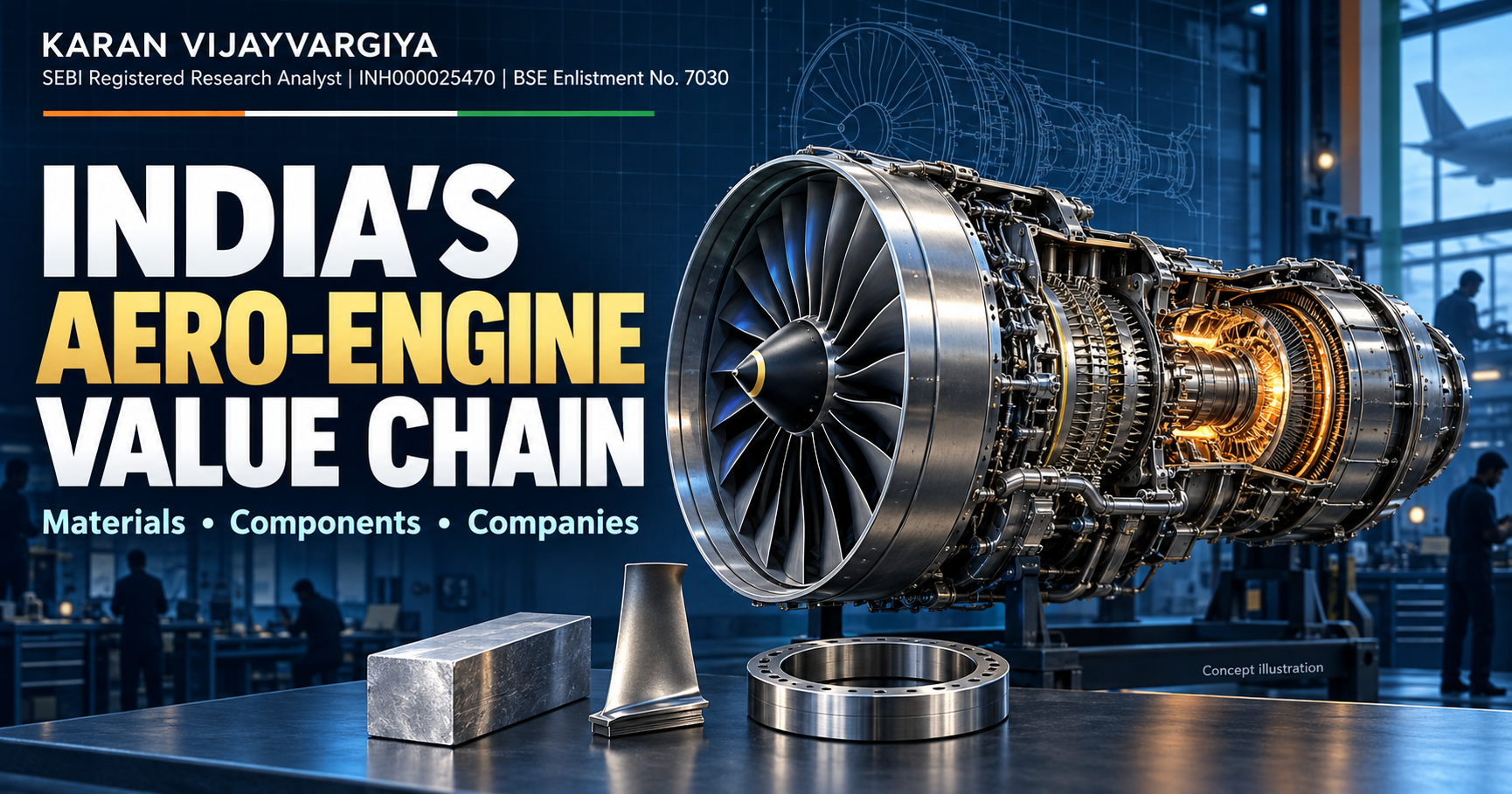
KARAN VIJAYVARGIYA | SEBI Registered Research Analyst | INH000025470 | BSE Enlistment No. 7030
India’s Aero-Engine Value Chain: The Indian Companies Behind the Engine
Approximately 5 minutes | Research checked: 28 September 2026
Disclosure: This article is for education and research only. It is not investment advice or a recommendation to buy or sell any security.
When we watch an aircraft take off, we see one machine. Behind its engine are businesses making metals, components, assemblies and tools.
Let me explain this through one question: what must happen before an engine is ready to fly?
An engine converts fuel energy into thrust or mechanical power. It must do this reliably while managing heat, weight and fuel consumption. Solving these problems creates opportunities across a specialised supply chain.
This follows my earlier aircraft ecosystem overview. Here, we focus on selected Indian listed companies and relevant unlisted businesses.
First, understand what happens inside
In a gas-turbine engine, the compressor squeezes incoming air. Fuel burns in the combustion section. The hot gases turn a turbine, which supplies power to the compressor and, depending on the engine, other equipment.
A turbofan produces thrust for the aircraft. A turboprop drives a propeller. A turboshaft supplies power through a transmission to a helicopter’s rotors. Different applications need different designs. Technical reference: NASA.
Now follow the manufacturing journey
Think of the chain like this:
Special materials → cast or forged shapes → precision components → engine modules → assembly and testing → maintenance
Each step solves a different problem:
- Materials: Alloys must handle the loads and temperatures of their intended location.
- Casting and forging: Metal is converted into shapes suitable for further processing. These are different manufacturing routes.
- Precision components: Machining creates the required dimensions and features in blades, discs, shafts and casings.
- Modules and systems: Components work with bearings, fuel and oil equipment, sensors and controls.
- Integration and testing: The assembled engine must meet its programme’s performance and safety requirements.
- Maintenance: Inspection, repairs and replacement parts help keep engines serviceable.
Engineering, inspection and documented quality checks run across this journey. The chain is a simplified map; every part does not pass through identical steps. The companies below illustrate these roles.
Where do Indian listed companies participate?
These are selected examples based on company disclosures, rather than a complete industry directory. Listing status was checked against the NSE equity list.
| Listed company | Role to understand |
|---|---|
| Hindustan Aeronautics — HAL | Participates in engine development and production. The Shakti helicopter engine is an example of a partnered programme. Source |
| Mishra Dhatu Nigam — MIDHANI | Supplies superalloys and titanium alloys for indigenous aero-engine programmes. This is the materials stage. Source |
| PTC Industries | Its subsidiary Aerolloy provides exposure to titanium and superalloy materials and aerospace castings. Source |
| Azad Engineering | Manufactures precision components for aero-engines and propulsion systems. Source |
| Bharat Forge | Discloses engine-component capabilities including titanium fan blades, shafts and discs. Source |
| Unimech Aerospace and Manufacturing | Makes specialised tooling used in engine production and maintenance. These tools support the engine’s lifecycle. Source |
When I study these companies, I first identify the product being sold. A material supplier, component maker and tooling manufacturer have different customers, costs and responsibilities. Their total company revenue should not automatically be treated as aero-engine revenue.
The unlisted Indian names also matter
- Aerolloy Technologies: An unlisted, wholly owned subsidiary of listed PTC Industries. Its announced casting-supply agreement includes critical aero-engine components. Parent and subsidiary should not be counted as two separate listed investments. Source
- Godrej Aerospace: The aerospace business of Godrej & Boyce, with engine-module, tubing and ducting capabilities. It has no separate listed equity; other listed Godrej businesses are not interchangeable proxies. Source
- Tata Advanced Systems: An unlisted Tata Sons subsidiary whose engine capabilities include compressor casings, seals, heat shields, bearing housings and fuel-system pipes. Products, ownership.
Where can the chain get stuck?
My research lens is to examine four possible bottlenecks: suitable materials, repeatable manufacturing quality, testing and customer approvals, and coordinated delivery from suppliers.
Consider a factory with new machines. Its output still needs to meet specifications and receive customer acceptance. Installed capacity alone does not establish saleable production.
India’s progress also needs programme-specific interpretation. In July 2026, the government reported delivery of a GTRE-designed, 350 kg-thrust-class expendable turbojet manufactured and assembled by Azad Engineering. That is a specific milestone; it does not establish mastery of every aircraft-engine category. Ministry of Defence.
How does this become a business?
Suppliers earn by delivering accepted materials, parts, assemblies, tooling or services. Their economics depend on pricing, usable output, factory utilisation and payment terms.
For example, rejected parts can consume material and machine time without producing an accepted sale. Inventory and unpaid customer bills can also tie up cash.
I would track:
- What is qualified, and what remains under development?
- Are announced orders turning into accepted deliveries?
- How much revenue actually comes from this activity?
- Are profits converting into cash?
- How dependent is the business on a few customers or programmes?
India’s engine opportunity becomes easier to understand when we connect the product, the company’s exact role, its execution record and its cash generation.
Explore my research services
For ongoing equity research, you can explore my
Equity Growth & Wealth Pack,
Tactical Growth Pack — Positional Trade,
Momentum Edge Pack — Swing Trading.
Please review the plan details, suitability and risk disclosures before subscribing. Analyst profile and contact details.
Disclaimer
This article is for education and research purposes only. It is not investment advice or a recommendation to buy, sell or hold any security. Aerospace businesses face technology, qualification, customer-concentration, supply-chain, funding and execution risks. Please conduct your own due diligence and consult a qualified financial adviser before making investment decisions.
Disclosure: The author, associates and relatives have no financial interest or holdings in the securities of the listed companies discussed in this article as of 28 September 2026.
The securities quoted are for illustration only and are not recommendatory.
Investment in securities market are subject to market risks. Read all the related documents carefully before investing.
Registration granted by SEBI, enlistment with BSE and certification from NISM in no way guarantee performance of the intermediary or provide any assurance of returns to investors.