
Can ChatGPT Predict Stock Prices?

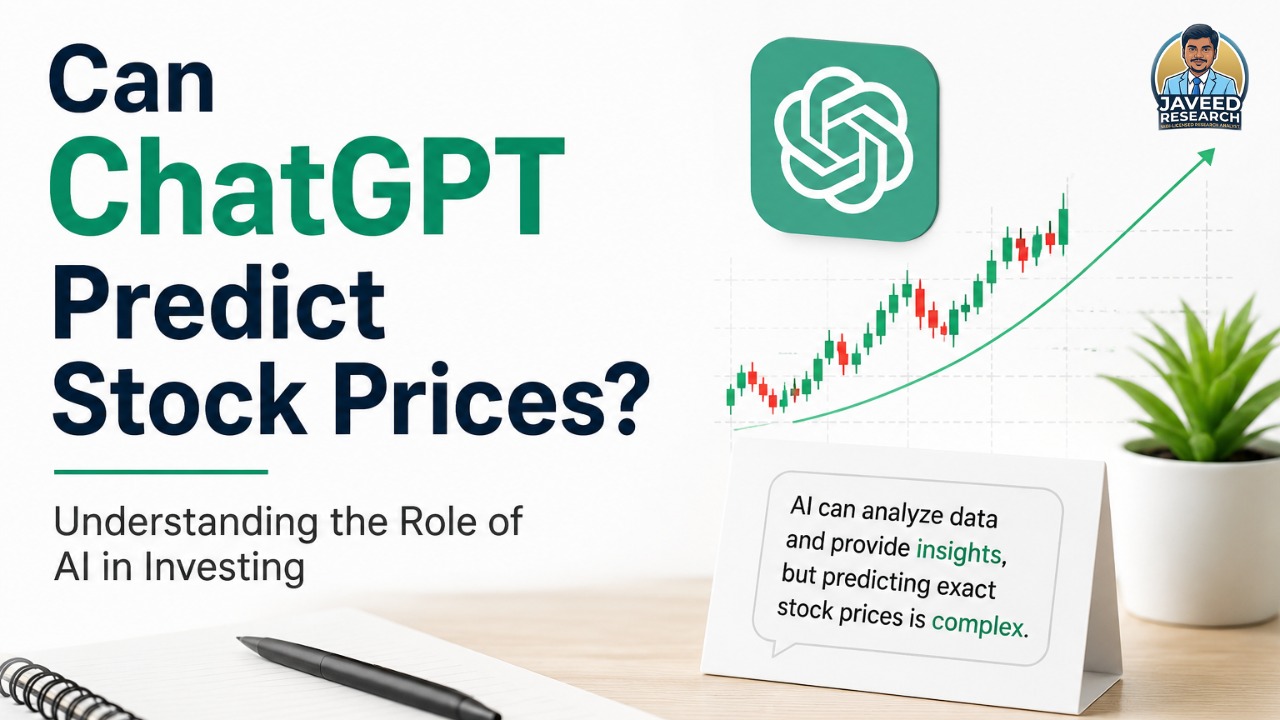
Artificial intelligence has transformed the way people search for information, write content, analyze data, and even make financial decisions. Among the many questions investors ask today, one stands out:
Can ChatGPT predict stock prices?
It's a fair question. If AI can summarize annual reports, explain financial concepts, and analyze market news within seconds, can it also tell you which stock will go up tomorrow?
The short answer is no.
The longer answer is much more interesting.
While ChatGPT can be a powerful research assistant for investors, it is not a crystal ball that can accurately predict future stock prices. Understanding this difference can help investors use AI wisely instead of relying on it blindly.
Why Predicting Stock Prices Is So Difficult
The stock market is influenced by thousands of variables every single day.
Some of the biggest factors include:
- Company earnings
- Economic indicators
- Interest rate changes
- Government policies
- Global events
- Investor psychology
- Institutional buying and selling
- Market sentiment
- Unexpected news
Many of these factors are unpredictable.
Even experienced investors and professional fund managers cannot consistently forecast short-term market movements.
If humans struggle despite years of experience, expecting an AI chatbot to predict exact stock prices is unrealistic.
What ChatGPT Actually Does
ChatGPT is a language model.
Its strength lies in understanding information, identifying patterns in text, explaining concepts, and generating human-like responses.
It can help investors by:
Explaining Financial Concepts
Whether it's P/E ratio, EPS, market capitalization, or free cash flow, ChatGPT can simplify complex financial terms.
Summarizing Annual Reports
Instead of reading hundreds of pages, investors can understand the key highlights much faster.
Comparing Companies
AI can organize publicly available information into easy-to-understand comparisons.
Analyzing News
It can summarize financial news and explain how certain events may influence different industries.
Generating Investment Checklists
ChatGPT can create structured frameworks for evaluating companies before investing.
These are valuable uses because they improve research and save time.
What ChatGPT Cannot Do
Many beginners assume ChatGPT knows tomorrow's market.
It doesn't.
AI cannot accurately predict:
- Tomorrow's stock price
- Next week's market direction
- Exact entry and exit points
- Guaranteed multibagger stocks
- Future earnings surprises
- Sudden geopolitical events
Markets react to new information every second.
No AI can consistently predict events that haven't happened yet.
While some research suggests large language models can extract useful signals from news and sentiment, those findings are typically limited to specific datasets and do not mean AI can reliably forecast future stock prices across real-world markets.
Can AI Improve Investment Decisions?
Absolutely.
But there's an important difference between prediction and decision support.
Think of AI as a research assistant rather than a portfolio manager.
AI can help you:
- Understand businesses faster
- Organize financial data
- Compare investment opportunities
- Identify risks
- Analyze market sentiment
- Build watchlists
- Generate research questions
The final investment decision should still involve human judgment, financial knowledge, and proper risk management.
Recent research also suggests that AI is most effective when combined with investor knowledge rather than replacing it entirely.
The Biggest Risk of Relying Only on AI
One of the biggest mistakes investors make is assuming that confident answers are always correct.
AI generates responses based on patterns in data.
It does not possess certainty about future market movements.
If investors blindly follow AI-generated stock recommendations without their own research, they may expose themselves to unnecessary risk.
Successful investing has always required:
- Patience
- Discipline
- Risk management
- Diversification
- Continuous learning
AI cannot replace these principles.
A Smarter Way to Use ChatGPT
Instead of asking:
"Which stock will double next month?"
Ask better questions like:
- What are the strengths and weaknesses of this company?
- Explain this company's latest quarterly results.
- Compare two companies in the same sector.
- What risks should I consider before investing?
- Summarize this annual report.
- Explain the business model in simple terms.
Better questions produce more useful insights.
Human Expertise Still Matters
Technology continues to improve, but investing is about more than processing information.
Experienced analysts evaluate:
- Management quality
- Industry cycles
- Competitive advantages
- Business sustainability
- Valuation
- Macroeconomic trends
- Investor behavior
These require judgment, experience, and context.
AI can assist this process, but it cannot fully replace it.
Some recent studies have even found that AI-driven trading strategies often struggle to outperform simple long-term investing approaches across changing market conditions.
The Future of AI in Investing
Artificial Intelligence will undoubtedly become an increasingly important part of financial research.
We can expect AI to improve in areas such as:
- Market screening
- Risk analysis
- Portfolio monitoring
- Financial education
- Company research
- News interpretation
However, successful investing will continue to depend on informed decision-making rather than automated predictions.
The best investors will likely combine AI-powered research with disciplined analysis and sound investment principles.
Final Thoughts
Can ChatGPT predict stock prices?
Not with consistent accuracy.
But that doesn't mean it has no value.
Used correctly, AI can simplify research, improve financial understanding, organize information, and help investors make more informed decisions. It should be viewed as a powerful assistant rather than a replacement for experience, critical thinking, or professional investment analysis. Smart investing is built on knowledge, discipline, and a well-defined strategy, and AI works best when it supports those foundations instead of replacing them.
Successful investing isn't about finding shortcuts or relying on AI to predict tomorrow's market. It's about building the knowledge and discipline to make informed financial decisions. At Javeed Research, you'll gain practical insights into stock market analysis, risk management, and long-term investing strategies designed to help you become a more confident investor. Explore expert market education and investment guidance at https://javeedresearch.com/.