
The Tax Paradox: Why the Harshest Tobacco Tax in a Decade May Be Godfrey Phillips' Best Friend

A cigarette company is not a factory. It is a toll booth on a habit. When the government raises the toll, the company collects the higher toll and the smoker pays it. That is the entire thesis, and FY26 just proved it in real time.
The tax event. On 1 February 2026 cigarettes moved to 40% GST and a fresh excise duty of Rs 2,050 to Rs 8,500 per thousand sticks replaced the old cess. Total tax now sits in the 40-50% range of retail price, one of the sharpest hikes in years. Godfrey Phillips fell as much as 19% in a single session on the notification, with analysts warning of up to 800 basis points of margin compression in Q1 FY27. Here is what most people miss: that warning covers one or two quarters. The price hikes are permanent. Once the consumer accepts the new pack price, and history says he does, the entire hike becomes margin for the years that follow.
The paradox, confirmed this cycle. When Godfrey Phillips and ITC announced fresh price hikes in April and May 2026, their shares rallied instead of falling. Pocket Marlboro moved from Rs 70 to Rs 85, a 21% hike in one step; Gold Flake Superstar from Rs 70 to Rs 79. The companies did not absorb the tax. The smoker did. Since the crash the company has raised prices twice, reported the highest quarterly profit in its 90-year history (+87% YoY), and the stock has quietly built a base about 48% below its all-time high.
The moats, in plain words. Regulatory moat: advertising bans and licensing mean no new competitor can build a cigarette brand in India. Brand moat: Marlboro is the most recognised cigarette brand on earth, and only one company in India is allowed to sell it. Distribution moat: reaching lakhs of paan shops daily takes decades. Balance-sheet moat: near-zero debt means tax shocks bruise a quarter or two but never threaten the company. Add ROE near 25%, a 5-year profit CAGR of 37.9%, and Rs 50 per share in FY26 dividends.
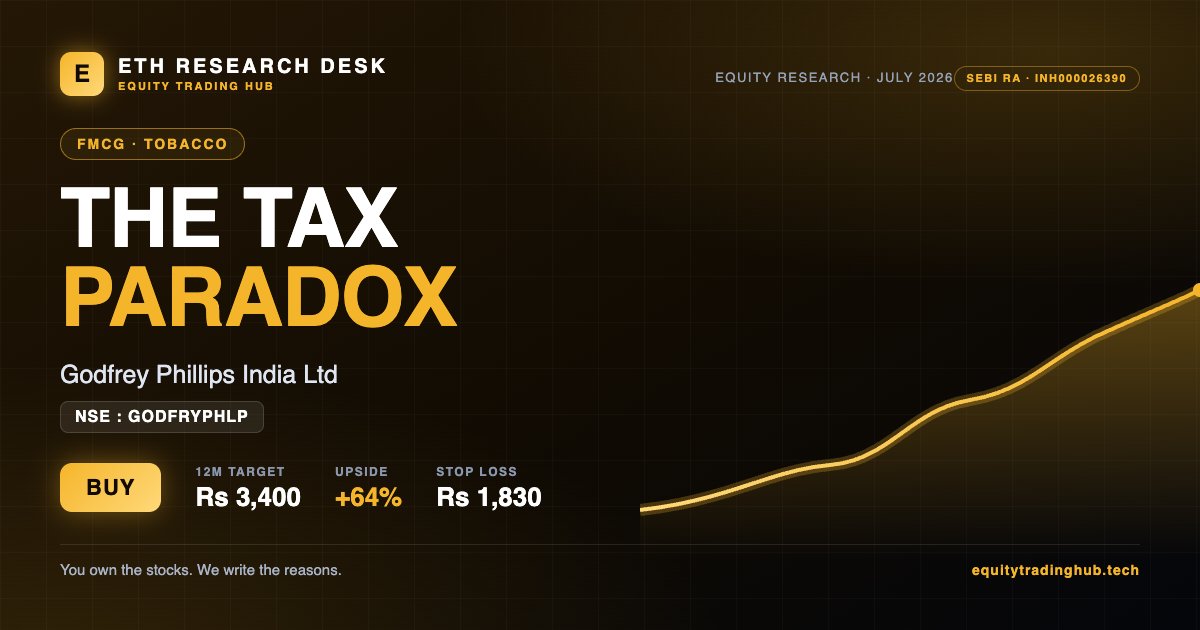
Valuation and the Rs 3,400 target. The market is still pricing the punishment. Nobody is pricing the recovery. That gap is the trade. Our 12-month target is Rs 3,400, tracked in stages.
How we are playing it (swing). Accumulate in the Rs 2,050-2,180 zone. Staged swing objectives are Rs 2,525 then Rs 2,700; book partial profits at each. This is a defensive, low-beta name (beta ~0.3) - position it as a base holding, not a chase.
What would prove us wrong. A weekly close below Rs 1,830 is our thesis-check and exit. If it triggers, we publish a review note rather than quietly hoping.
Disclosures: Prepared by the ETH Research Desk. Prateek Goel is a SEBI-Registered Research Analyst (Reg. No. INH000026390). Tobacco is a sin sector with regulatory risk; this is research, not investment advice, and does not consider your personal circumstances. Equities carry risk including loss of capital. Verify the live price before acting. The analyst/desk may hold positions in the securities discussed.