
The Maize Machine: Why Gujarat Ambuja Exports Just Became a Different Company

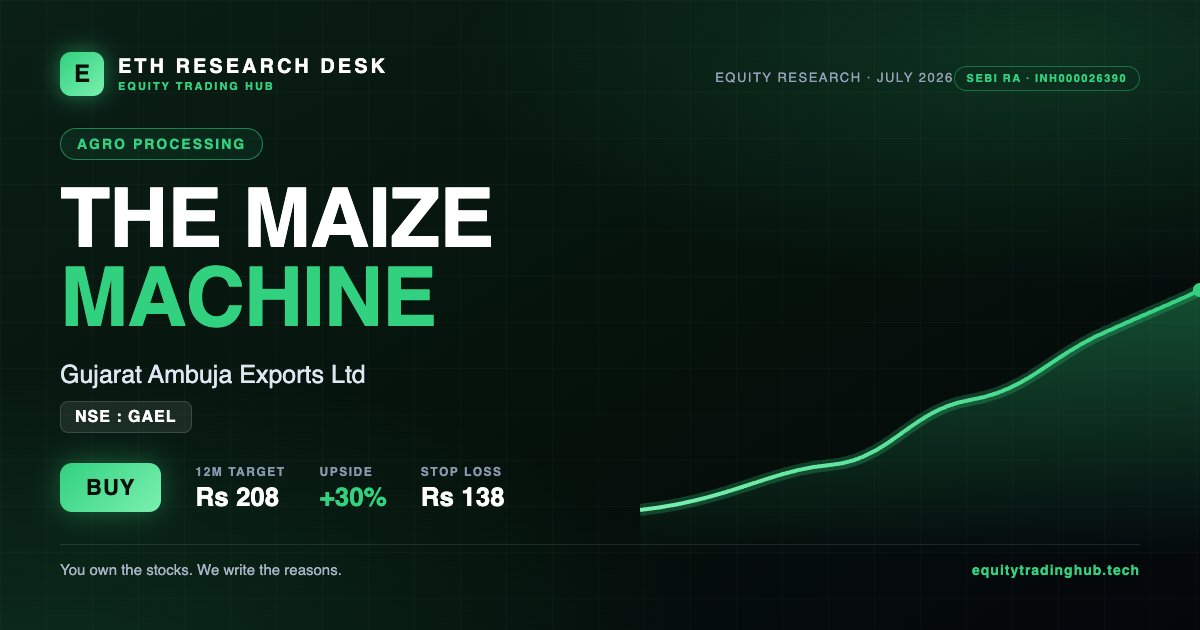
Every few years a commodity processor crosses the line into specialty ingredients and the market re-prices it as a different company. Gujarat Ambuja Exports (GAEL) crossed that line in Q4 FY26, and the re-pricing has barely started.
The thesis in three sentences. GAEL controls roughly a fifth of India's organised maize processing capacity and has spent two years converting that scale into chemistry: specialty fermentation at Hubli, a tripled maltodextrin line, a new 1,200 TPD plant at Sitarganj running at optimal utilisation, and an approved 180 KLPD grain-based ethanol and ENA plant at Malda. Q4 FY26 was the first quarter where all of it showed up together: revenue up 15.7%, standalone profit up 314% to Rs 135.5 crore, EBITDA margin up from 4.9% to 13.3%, driving FY26 PAT to a record Rs 305 crore. The stock trades around 24x that record year with a net-cash balance sheet.
The quarter that changed the multiple's job. Operating leverage in maize processing is violent once utilisation crosses a threshold, and it just did. We will not annualise a 13.3% margin, agro processing does not work that way, but the quarter proves what the installed base earns when utilisation, procurement and mix line up. The Other Agro Processing division's segment profit nearly tripled; sodium gluconate is in commercial production; maltodextrin capacity tripled to 23,000 MTPA in March 2026.
A balance sheet that funds all of it. Borrowings of about Rs 2.6 crore against net worth above Rs 3,000 crore, interest cover near 37x, and roughly Rs 465 crore of FY26 investment paid for internally. The entire capex pipeline through FY28 needs no dilution and no meaningful debt. Promoter stake is steady at 63.84% with zero pledge.
The forensic scorecard. Promoter pledge: clean. Leverage: clean. Capex funding: clean. The three items we are watching are other-income share, margin stability across quarters (4.9% to 13.3% within five quarters), and thin institutional ownership near 3% - each converted into a tripwire below.
Valuation and the Rs 208 target. On next year's earnings at today's own 24x multiple, no re-rating assumed, the stock is worth about Rs 208 on a 12-month view. The probability-weighted value across bear/base/bull works out near Rs 202, effectively the base case - the number does not depend on the bull case showing up.
How we are playing it (swing). Accumulate in the Rs 152-162 zone rather than chasing. A weekly close above Rs 168 opens the direct test of the 52-week high at Rs 178; through 178 the stock is in price discovery with Rs 192 and Rs 208 as staged objectives. Book partial profits in stages at Rs 178 and Rs 192.
What would prove us wrong. A weekly close below Rs 138 breaks the uptrend structure and is our exit, regardless of the fundamentals. We publish our reasons to be wrong before the first rupee is committed, and we will publish a review note if any trigger, rather than quietly hoping.
Disclosures: Prepared by the ETH Research Desk. Prateek Goel is a SEBI-Registered Research Analyst (Reg. No. INH000026390). This is research, not investment advice; it does not consider your personal financial situation. Investing in equities carries risk, including loss of capital. Verify the live price before acting. The analyst and the desk may hold positions in the securities discussed.