
The Toughest Sanctions in History Just Hit Iran's Oil. India Sits in the Middle of the Map.

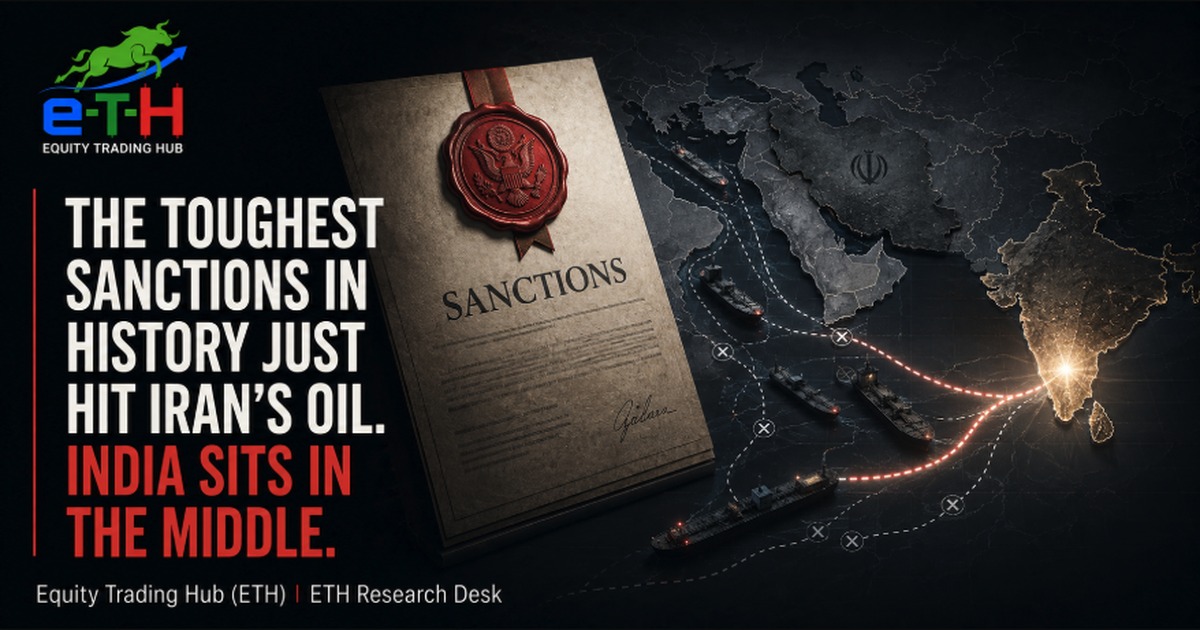
On Monday, Washington announced what its Treasury Secretary called the toughest sanctions in history on Iran's oil trade. The novelty is not the adjective. It is the target. These measures aim at the buyers of Iranian crude, and one statistic decides how much that matters: China reportedly takes more than 80 percent of Iran's shipped barrels. Threaten those flows and you are not squeezing Iran alone, you are renegotiating the world's oil map, with India's import bill sitting in the middle of it.
WHAT SECONDARY SANCTIONS ACTUALLY DO
Primary sanctions stop Americans dealing with Iran; those have existed for years and oil kept flowing through shadow fleets and discounted cargoes. Secondary sanctions are the escalation: they threaten anyone, anywhere, who touches the trade, with exclusion from the dollar system. Banks stop financing cargoes, insurers stop covering tankers, ports hesitate. The oil does not vanish, but every barrel gets harder, costlier and slower to move. The market's question this week is brutally simple: does China comply, defy, or negotiate? Each answer produces a different oil price.
THE THREE SCENARIOS FOR INDIA
Scenario one, compliance: a meaningful slice of Iranian supply leaves the market, crude pushes toward and past $100, and India's trade deficit, rupee and inflation all take the hit our $94 sector map described, with OMCs, aviation, paints and consumer names bearing the first wave. Scenario two, defiance and workarounds: flows continue at deeper discounts through grey channels, crude keeps a risk premium in the $90s but avoids a spike, and Indian markets stay in the choppy, rotational grind of the past fortnight. Scenario three, the negotiated off-ramp: sanctions become leverage for a broader Gulf de-escalation, the risk premium deflates, and the most crowded trades of the month, long gold, long defensives, short oil-consumers, unwind hard and fast. Portfolios positioned for only one of these three are gambling, not investing.
WHY INDIA IS EXPOSED EITHER WAY
India largely stopped buying Iranian crude under earlier sanctions, so the direct supply loss is small. The exposure is indirect and larger: India imports most of its oil at world prices, so anything that tightens global supply taxes India regardless of whose barrels disappear. And there is a second-order risk the market is only beginning to price: if secondary sanctions become the accepted tool for policing oil buyers, the precedent matters for every large importer of discounted sanctioned crude, a category in which India has its own well-known position. The instrument unveiled against Iran's customers this week is one future headline away from complicating India's other discounted barrel.
THE SIGNALS THAT TELL YOU WHICH SCENARIO IS RUNNING
Watch four things, in order. Brent's behaviour around $95: holding below it says the market believes in workarounds, a decisive break above says compliance is biting. Tanker and freight rates on Gulf-to-Asia routes, which price the friction before official data does. Any Chinese official response, because silence plus quiet buying is defiance, and public negotiation is the off-ramp. And at home, the rupee: it is the single cleanest gauge of how seriously Indian markets are taking the oil math on any given day.
This is the rare week where geopolitics is not background noise for Indian investors. It is the main input. Position for ranges, not certainties, keep the hedges that are already working, and let the four signals, not the headlines, tell you which world you are in.
You own the stocks. We write the reasons. Every single time.
DISCLAIMER: This article is for education and information only. It is not investment advice, not a recommendation, and not a solicitation to buy or sell any security or commodity. Details of sanctions are as reported in media on 24 and 25 August 2026 and may evolve; verify from official sources. Prateek Goel is a SEBI Registered Research Analyst (INH000025902). Investments in the securities market are subject to market risks. Read all related documents carefully before investing. Registration granted by SEBI and certification from NISM in no way guarantee the performance of the intermediary or provide any assurance of returns to investors.