
Demat 2.0 Explained: How Tokenised Bonds and Digital Rupee Settlement Could Work

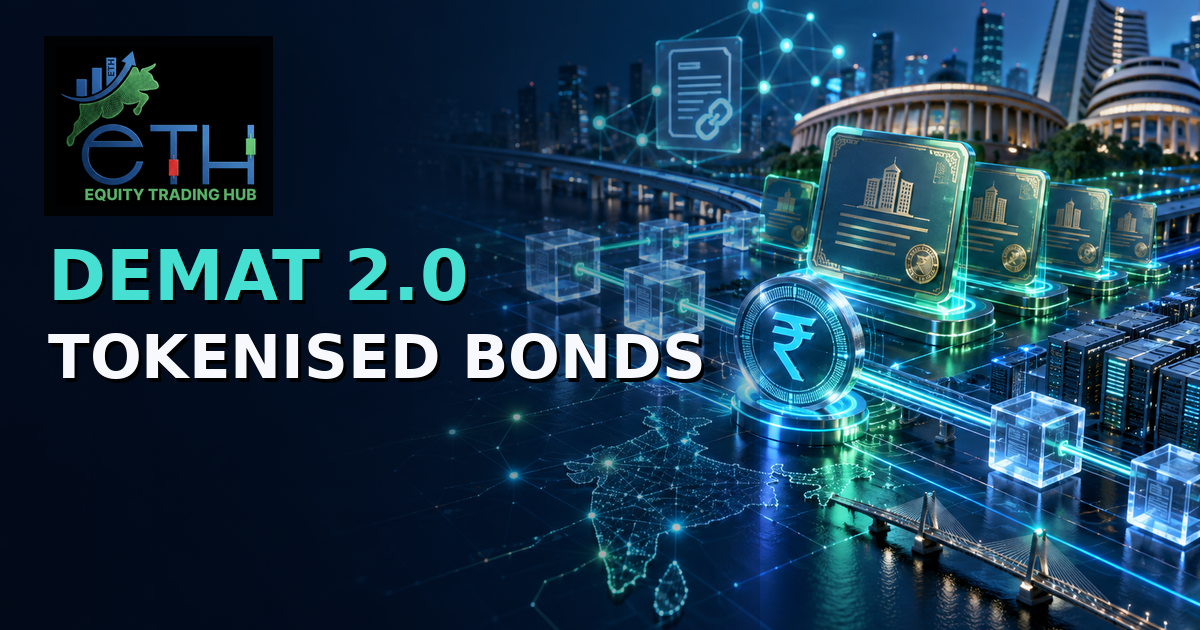
India's next demat experiment is not about putting another app on an investor's phone. It is about changing how ownership and payment move behind the screen.
SEBI and RBI launched the Demat 2.0 pilot on 10 September 2026 to test tokenised corporate bonds, central bank digital currency settlement and smart-contract-based servicing.
The pilot began with three issuers. REC and Larsen & Toubro each issued ₹500 crore of tokenised bonds, while IIFL issued ₹25 crore. The combined pilot value is ₹1,025 crore.
The first phase is restricted to institutional investors. Retail participation is expected only later, subject to the pilot's results and further regulatory decisions.
What Demat 2.0 is trying to change
Traditional dematerialisation replaced paper certificates with electronic ownership records. Demat 2.0 tests whether the security and payment legs can sit on connected digital infrastructure.
The tokenised bond represents the security. RBI's wholesale central bank digital currency represents the settlement asset. Smart contracts can automate specific instructions when predefined conditions are met.
The system is intended to connect with RBI's Unified Market Interface so securities and funds can settle simultaneously. This is often called atomic settlement.
The practical objective is to reduce the gap between delivery and payment, lower reconciliation work and reduce settlement risk.
Why asset servicing matters
Bond settlement is only one part of the process. Interest payments, redemptions and ownership updates also require data to move between issuers, registrars, depositories and banks.
Under the proposed shared-ledger structure, authorised institutions can access the required bondholder information together. Smart contracts can then help route scheduled payments through CBDC wallets.
This could reduce repeated file sharing and manual reconciliation. It does not mean every corporate action becomes risk-free or legally automatic.
Tokenisation does not remove credit risk
A tokenised bond remains a claim on an issuer. Faster settlement does not improve the issuer's ability to repay.
Investors must still assess credit quality, covenants, interest-rate risk, liquidity and legal documentation. Technology can change the settlement rail without changing the underlying economics.
The pilot is also designed to preserve legal certainty around ownership. That issue is essential because a digital token must correspond clearly with enforceable investor rights.
Where the experiment could go next
SEBI Chairman Tuhin Kanta Pandey said the model could later extend to equities, mutual funds and gold. RBI has separately been exploring gold tokenisation.
SEBI also plans to implement IOSCO's supervisory toolkit for artificial intelligence in the Indian securities market. The regulator's stated objective is stronger risk management and an adaptable AI-governance framework for regulated entities.
These plans are directional. They should not be treated as confirmation that retail tokenised shares, funds or gold will launch on a fixed date.
Trader and investor watch points
- Results from the ₹1,025 crore institutional pilot.
- The legal treatment of token ownership and investor claims.
- Settlement speed, operational resilience and cyber-security controls.
- Rules governing smart contracts and correction of erroneous transactions.
- Any timetable for retail participation.
- Expansion to commercial paper, equities, mutual funds or gold.
- SEBI guidance on AI governance for market intermediaries.
Risk and uncertainty
The project remains a pilot. Distributed-ledger systems can introduce technology, governance, privacy and cyber-security risks. Retail access, product scope and settlement rules may change after testing.
Sources
- The Indian Express, SEBI and RBI launch Demat 2.0 pilot, updated 11 September 2026
- Financial Express, Demat 2.0 and IOSCO AI toolkit details, published 10 September 2026
Disclaimer
This article is published by Prateek Goel, SEBI Registered Research Analyst, registration number INH000026390, for educational and informational purposes only. It does not recommend any bond, digital asset or technology-linked investment. Registration granted by SEBI and certification from NISM do not guarantee performance or returns. Investments in the securities market are subject to market, credit, liquidity and operational risks. Read all related documents carefully before investing.