
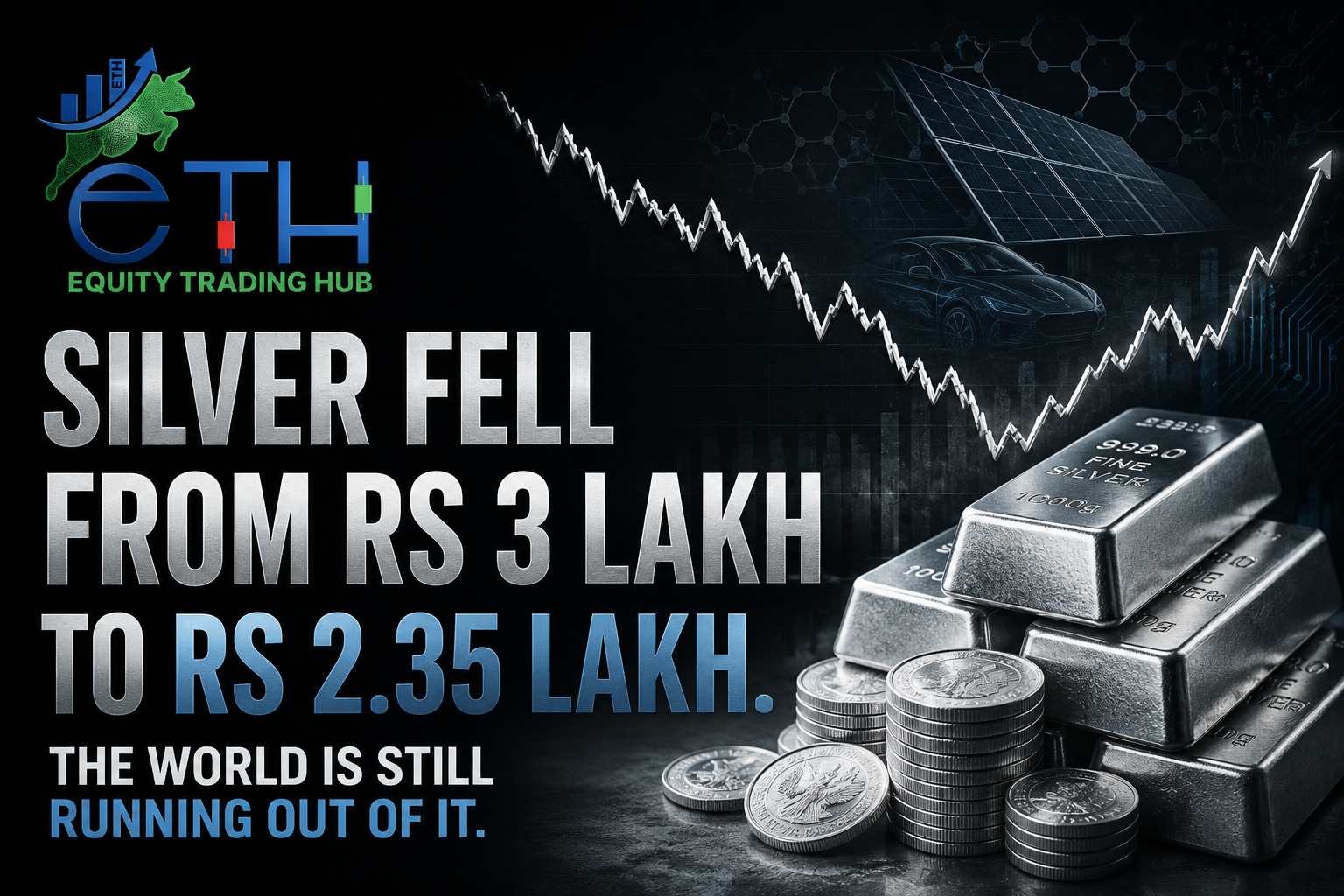
Silver Fell From Rs 3 Lakh to Rs 2.35 Lakh. The World Is Still Running Out of It.

Here is a riddle for you. Name the metal that the world has consumed more of than it has produced for six years in a row, that is essential to solar panels, electronics and electric vehicles, and that is currently on sale at roughly half the price it commanded six months ago.
The answer is silver, and the Research Desk is bullish on it at current prices. Let me walk you through why, without a single complicated word.
First, the fall itself. Silver hit an all time high of $121.62 per ounce in January 2026 and has since corrected roughly 52 percent to around $58. In India the move was cushioned but still sharp. MCX silver touched an intraday high above Rs 3 lakh per kilogram in mid May after the government raised import duty on precious metals from 6 percent to 15 percent, and today silver trades near Rs 2,35,000 per kilogram. So the question every investor is asking is simple. Is the story broken, or is the price just cheaper?
Our answer: the correction happened in the price, not in the thesis. Here is the evidence.
Start with the fundamental engine, because it is the strongest part. The World Silver Survey 2026, published in April, confirmed the sixth consecutive annual supply deficit, at 46.3 million ounces, wider than last year's 40.3 million ounce gap. In plain words, for six straight years the world has used more silver than its mines have dug up. The gap has been filled by drawing down old above ground stock, and that stock is not infinite.
'
Now the detail almost nobody tells you, and it is the most important fact in this entire article. Only about 26 percent of mined silver comes from actual silver mines. The rest arrives as a byproduct of copper, lead and zinc mines that answer to entirely different economics. Think about what that means. Even when silver prices double, miners cannot simply produce more of it, because most silver comes out of the ground only when someone is digging for something else. This is why the deficit has not fixed itself for six years. Supply is nearly deaf to price. Very few markets in the world work like this.
On the demand side, this is no longer your grandfather's silver. Around 58 percent of silver demand today is industrial. Every solar panel carries a paste of silver. Electric vehicles, electronics, data centres and the entire electrification wave all pull from the same shrinking pool. Silver has quietly become a technology metal wearing a precious metal's clothes.
Now the macro turn, which is what changed this week. US inflation for June came in at 3.5 percent, down sharply from 4.2 percent in May, and consumer prices actually fell month on month for the first time since 2020. Cooling inflation reduces the pressure on the US central bank to raise rates, and high rates are the single biggest enemy of metals that pay no interest. The US Federal Reserve meets on 28 and 29 July. A decision to hold rates takes the biggest weight off silver's back. Mark that date.
There is an India specific layer too. The 15 percent import duty now acts like a floor under domestic prices, since almost all our silver is imported and the duty is baked into every kilogram that lands here. And because silver is priced in dollars, any weakness in the rupee lifts Indian silver prices even on days when global prices do nothing.
What about the experts? JP Morgan expects silver to average around $81 per ounce in 2026, HSBC around $75, and the London Bullion Market Association's analyst survey sits even higher, while Bank of America is the cautious one at around $56. We quote the cautious voice deliberately. A desk that only shows you the numbers that agree with it is selling, not researching. But notice that even after a 52 percent crash, most major institutions see silver ending the year well above where it trades today.
History offers a rhyme as well. In the 2011 cycle, silver fell roughly 60 percent from its peak before basing and forming the foundation of the next structural advance. Deep corrections after vertical rallies are how this metal has always behaved. The 2026 fall is violent but it is not unusual, and the supply deficit backdrop today is something the 2011 market never had.
So here is the Desk's checklist, written down the way we write everything, before the outcome is known.
Watch 28 and 29 July. A rate hold in the US is the green light this setup is waiting for.
Watch the $60 to $61 zone globally. Holding above it keeps the recovery structure alive, and a sustained move through $65 opens the door higher.
Watch the year end institutional forecasts around the $75 to $81 area, which sit far above today's price.
And in the ETH tradition, here is what would prove us wrong. A surprise rate hike with hawkish guidance, a sustained break below $55 on the global price, or the next supply survey showing the deficit closing. If those happen, we will say so openly rather than quietly hoping. That is the standard this desk holds itself to.
Silver is violently volatile, far more than gold, and it should never be a giant slice of anyone's portfolio. Position size accordingly and never use money you cannot lock away. But when a metal the world cannot produce enough of goes on a 50 percent sale, two weeks before the event that could remove its biggest headwind, the Research Desk pays attention. We suggest you do too.
Know what you own, and know why you own it. The hype will take care of itself.
Prepared by the ETH Research Desk. Prateek Goel is a SEBI-Registered Research Analyst (Reg. No. INH000026390). This is research and market commentary, not personalised investment advice. Commodity prices are volatile and figures quoted are as of the drafting date, 16 July 2026. Verify live prices before acting. Investment in securities and commodities markets is subject to market risks.