
How will the Indian market for electric cars and scooters develop over the next three to five years?

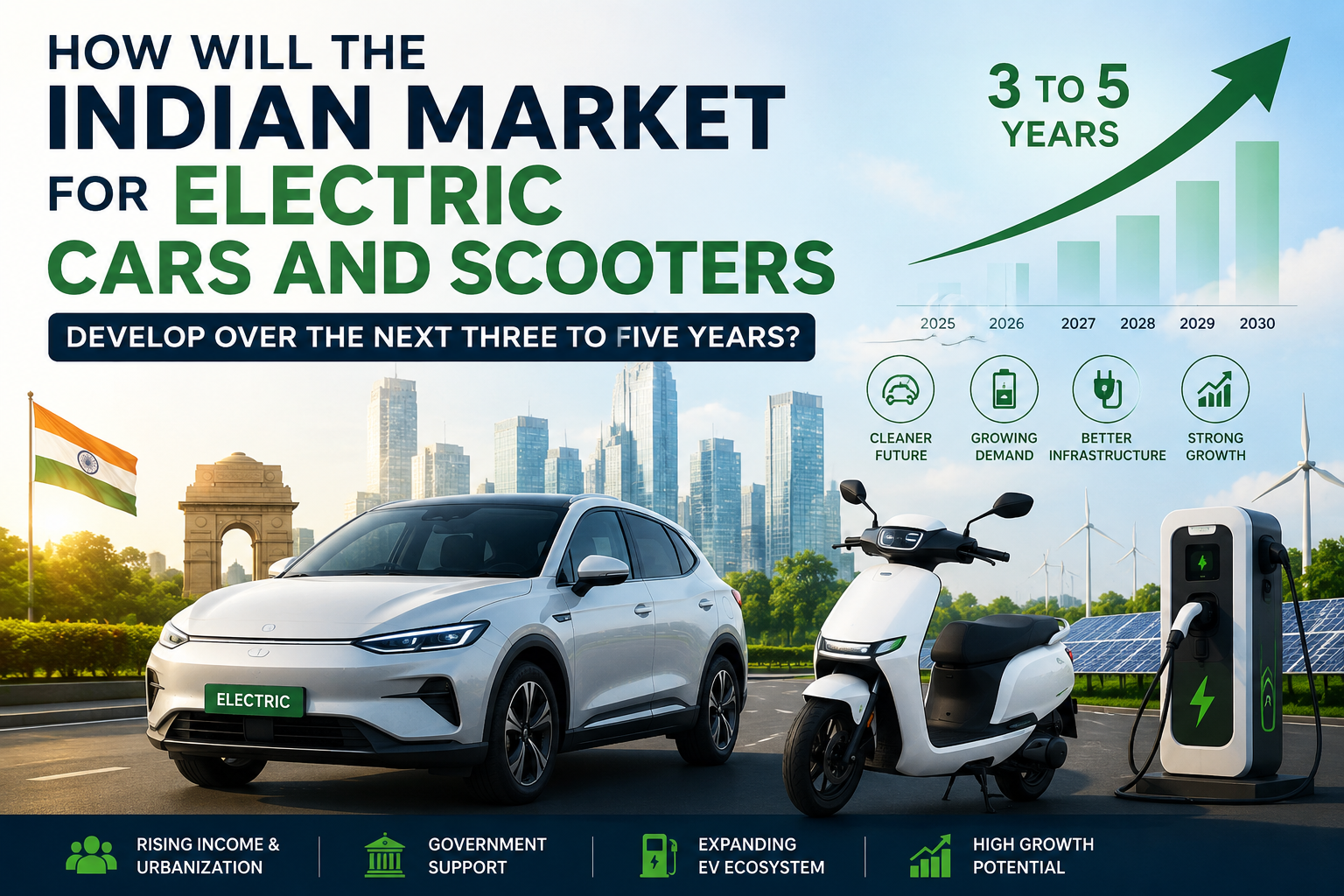
Over the next three to five years, India's electric vehicle market is expected to transition from early adoption to wider mainstream acceptance, with electric cars increasing more gradually and electric scooters leading the way. Urban commuting, fleet utilization, declining battery costs, improved charging availability, and favourable government policies will provide the most momentum.
Reasons for the market's expansion:
Due to their lower operating costs, ease of charging, and superior suitability for everyday city travel compared to many cars, electric two-wheelers are predicted to continue to increase at the quickest rate. According to industry projections, India's EV market might expand quickly over the next ten years, with two-wheelers and three-wheelers accounting for the majority of the volume.
Growth in electric cars will continue, albeit more slowly than in scooters due to factors like greater purchase costs, charging issues, and consumer reluctance. Nevertheless, increased availability, improved range, and cheaper battery prices should increase affordability and make EV vehicles more appealing to middle-class consumers and fleet managers.
What could happen during the next three to five years:
India is predicted to have a far greater EV footprint by 2030 than it does now, particularly in scooters and urban transportation. According to some predictions, EV adoption in two-wheelers could increase significantly, with scooters accounting for a sizable portion of this development.
Over the next three to five years, the following trends are likely to occur: More models of electric scooters in both high-end and low-cost categories. increased uptake by shared mobility fleets and delivery services. quicker growth of networks for public and residential charging. more regional production of EV components and batteries. Sales of electric vehicles have increased gradually but noticeably in large cities.
Challenges that remain:
The industry continues to face significant challenges. Battery prices must continue to decline, charging infrastructure must grow much more quickly, and buyers must have more faith in range, resale value, and service support.
Furthermore, the expansion of EVs in India won't be consistent. Smaller towns and rural areas, where access to charging stations and pricing continue to be major obstacles, will lag behind larger cities and states with more robust governmental support.
Overall outlook:
The most plausible situation is that electric scooters will emerge as a conventional selection for city dwellers, while electric vehicles will progressively gain traction at a steady pace. Within the next 3 to 5 years, the electric vehicle business in India is anticipated to grow increasingly competitive, with a greater emphasis on domestic manufacturing and practicality for regular users.
The most often mentioned names are Tata Motors, Mahindra & Mahindra, Bajaj Auto, Hero MotoCorp, TVS Motor, Ather Energy, Zeilo E-Mobility, Amara Raja Energy & Mobility, and KPIT Technologies. Investors may be tracked in the future.
How to consider investing in EVs:
A solid EV investment is typically more than simply an EV manufacturer; it can also be a battery manufacturer, a player in the charging market, a supplier of auto parts, or a software/engineering firm associated with the expansion of EVs. This is significant since certain businesses have more consistent profits than pure-play EV start-ups.