
Weekly Market Update: Weak Breadth, Rising Oil, and a Market at an Inflection Point

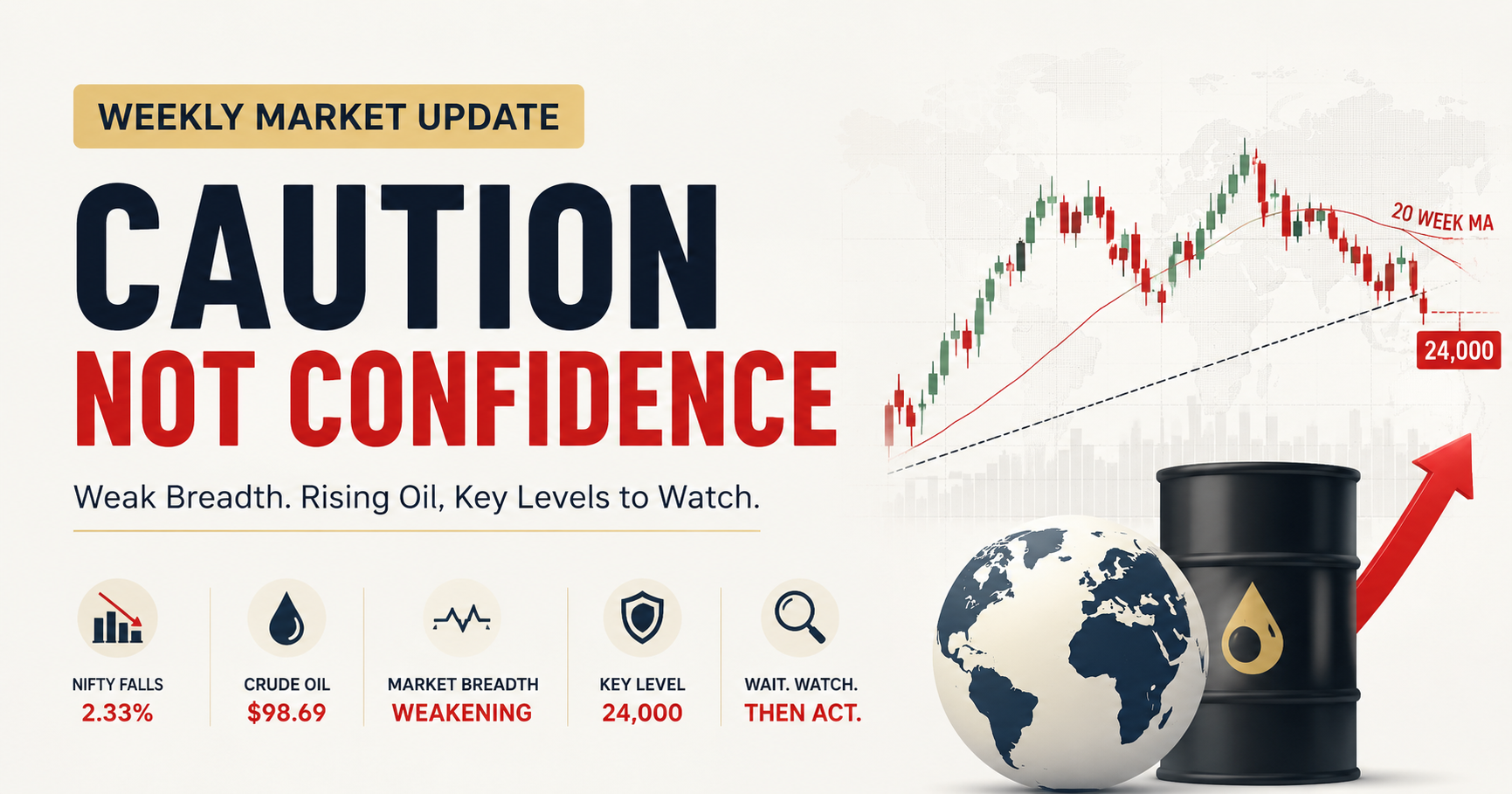
The Nifty 50 had a difficult week, declining 2.33%, and the weekly chart is beginning to show signs of weakness. The index continues to trade below its 20 week moving average, with the moving average itself sloping downward, a characteristic that generally reflects a deteriorating intermediate term trend. While this is not yet a decisive breakdown, it does suggest that investors should remain cautious rather than aggressively positioning for higher prices.

At the same time, the Nifty has reached an important technical support zone. A trendline drawn from the March 2026 lows continues to provide support, suggesting that the market is currently building a base rather than entering a confirmed downtrend. Markets often spend weeks consolidating before making a meaningful directional move, and that appears to be the phase we are currently in.
The key level to monitor remains 24,000. Unless the Nifty is able to reclaim and close above this level, the path of least resistance continues to be sideways to lower. While short term rallies are always possible, the broader technical structure does not yet support taking aggressive long positions.
Small Cap Index: Long Term Structure Remains Healthy
The Nifty Smallcap 100 Index declined a little over 2% during the week, but importantly, the broader technical picture remains constructive. Despite the recent weakness, the index continues to trade well above its critical support levels and has merely entered another period of consolidation.

From a technical perspective, the Smallcap 100 would only begin to look structurally weak if it were to fall below 17,500. With the index currently trading around 18,800, there remains a comfortable cushion before the long term uptrend comes under pressure.
Rather than viewing the recent decline as the beginning of a major correction, it appears more likely that the index is building another base before its next significant move. However, given the current macro environment and weakness in the broader market, investors should avoid assuming an immediate breakout. Patience remains essential.
Mid Cap Index Continues to Compress
The Nifty Midcap 100 Index declined 1.29% during the week. Unlike the sharp swings often seen in smaller companies, the midcap index has spent nearly three months trading within a remarkably tight range.
Since May, prices have largely moved sideways without establishing a meaningful trend in either direction. Such prolonged periods of contraction are often followed by expansion, although the eventual direction cannot be predicted with certainty.

At this stage, there is little evidence suggesting an imminent deep correction. Instead, the index appears to be storing energy for a larger move. Investors should therefore focus less on predicting direction and more on waiting for confirmation before increasing exposure.
Market Breadth Continues to Deteriorate
Perhaps the most important observation this week comes from market breadth. Only around 40% of stocks are currently trading above their 200 day moving average, while approximately 44% remain above their 50 day moving average. These numbers have steadily weakened over the past two weeks.

For momentum investors, breadth is often a better indicator than the headline index itself. When fewer than half of listed stocks remain above their longer term moving averages, it becomes increasingly difficult to find strong, sustained trends. Individual stocks become more prone to failed breakouts, increased volatility, and frequent stop loss hits.
Rather than reacting immediately to the weakening breadth, it would be prudent to observe how the market behaves over the next few trading sessions. Breadth often begins improving before the index itself recovers, making it an important indicator to monitor closely.
Geopolitical Developments Could Drive Short Term Volatility
Markets will also have to digest fresh geopolitical developments surrounding the Iran–US conflict. The immediate reaction of global markets will provide valuable information about investor sentiment. Rather than attempting to predict the outcome, it is better to observe how institutions respond once trading begins. Price remains the final judge, and allowing the market to reveal its direction is generally a more disciplined approach than anticipating it.
Crude Oil Has Become the Most Important Variable
Beyond the technical charts, crude oil deserves close attention over the coming weeks. Crude oil has surged roughly 45% over the past three weeks and is now trading near $98.69 per barrel. For an economy like India, which imports a significant portion of its energy requirements, elevated oil prices can create multiple challenges including inflationary pressure, pressure on corporate margins, and concerns around the fiscal and current account balances.
Historically, when crude oil remains above $95 to $100 per barrel, Indian equities often struggle to establish strong and sustained uptrends. Markets may not necessarily experience a sharp decline, but they frequently become volatile and directionless.
This environment is particularly challenging for momentum investors. Higher volatility combined with weaker market breadth often leads to more failed breakouts and increased stop loss hits, even when the broader indices remain relatively stable.
A meaningful decline in crude oil below $95 would significantly improve the market outlook. Until then, oil prices are likely to remain one of the most important variables influencing investor sentiment and overall market direction.
Outlook
The market currently sits at an important inflection point. The Nifty is testing long term trendline support while continuing to trade below key moving averages. Small caps and mid caps remain structurally healthy but are both consolidating after extended advances. Meanwhile, market breadth has weakened noticeably, suggesting that opportunities for momentum investing remain limited.
Adding to this cautious backdrop are elevated crude oil prices and geopolitical uncertainty, both of which have the potential to increase volatility over the coming weeks.
For now, patience remains the preferred strategy. A sustained move above 24,000 on the Nifty would improve the technical outlook considerably. Until then, preserving capital, managing risk carefully, and allowing the market to confirm its next direction remains the most prudent approach.