
Rare Earth Magnet shortage beneficiary Stock

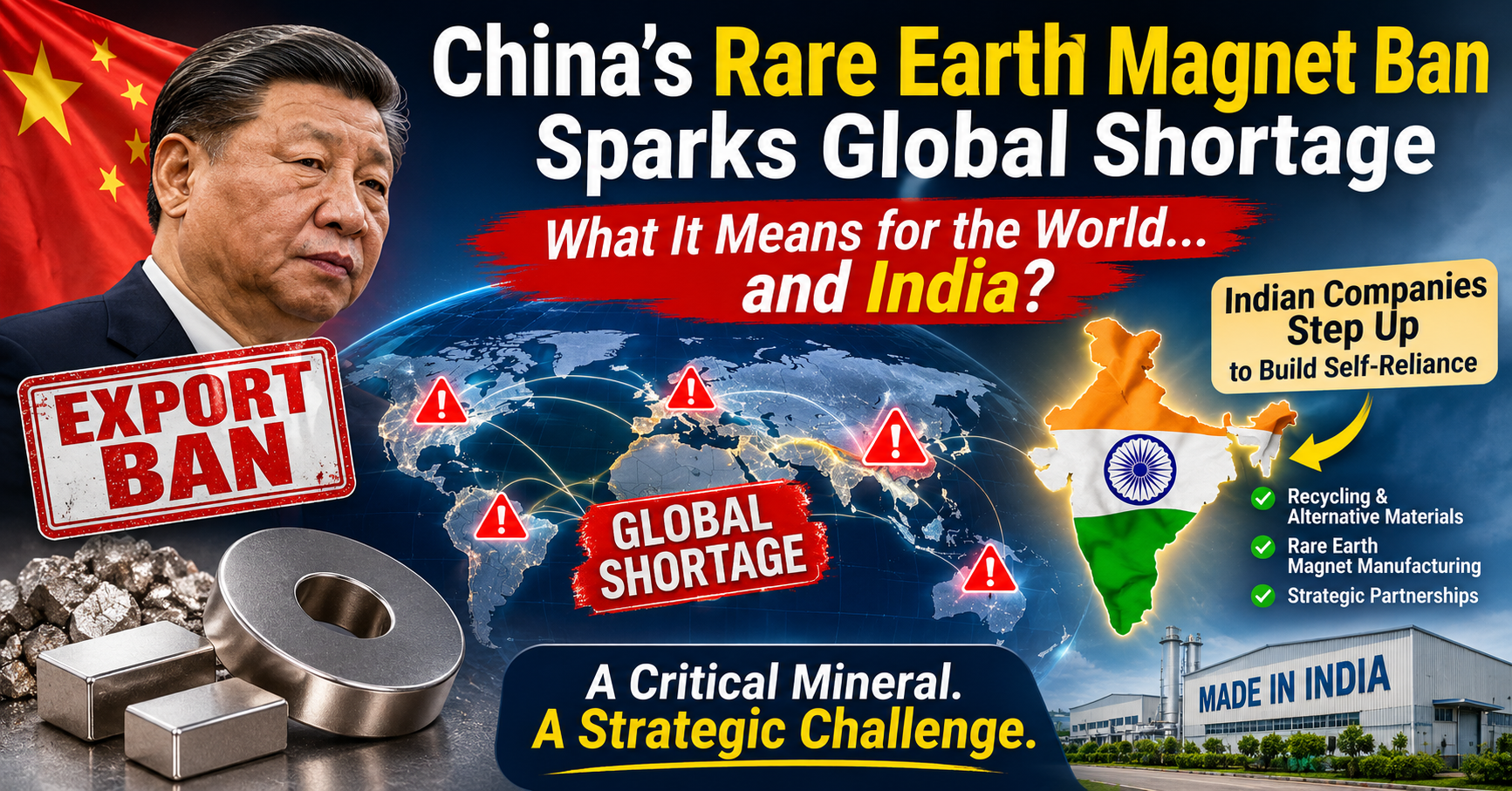
The Permanent Magnet Choke: China's 90% Grip on NdFeB and the Defense-EV Motor Vulnerability
Why electric mobility, wind turbines, and guided missile fins cannot turn without NdFeB magnets, and IREL's strategic monazite mandate.
Global TAM (2030) (Total Addressable Market = TAM)
$38.6 Billion
Worldwide Demand
Indian Market TAM (2030) (Total Addressable Market = TAM)
₹6,500 Cr
Domestic & Export Runway
Projected CAGR
+14.8%
Annual Compound Growth
Procurement Stretch
46 Weeks
vs Normal Historical Baseline
1. What is Short in Terms of Supply and Why?
Neodymium-Iron-Boron (NdFeB) Sintered Permanent Magnets are the most powerful magnetic materials known to science. By doping neodymium magnets with heavy rare earths—specifically Dysprosium (Dy) and Terbium (Tb)—the magnetic microstructure maintains high coercivity and resists demagnetization at severe operating temperatures (up to 200°C).
The Total Chinese Chokepoint
China controls:
- ~70% of global rare earth mining.
- >90% of commercial rare earth solvent separation and refining.
- >99% of heavy rare earth separation (Dysprosium and Terbium).
- ~92% of global sintered NdFeB magnet manufacturing.
In late 2023, China banned the export of rare earth extraction, separation, and magnet manufacturing equipment. Every electric vehicle traction motor requires ~2 to 3 kg of NdFeB magnets, and direct-drive offshore wind turbine generators consume up to 650 kg per megawatt. In defense, every F-35 fighter requires 417 kg of rare earth materials for radar actuators, flight control servos, and electronic warfare suites.
2. What Opportunities and Challenges Arise for the World?
Global Challenges:
- Severe Heavy Rare Earth Bottleneck: Even when Western miners extract neodymium (like MP Materials at Mountain Pass, California), separating Dysprosium and Terbium requires hazardous solvent extraction facilities with hundreds of mixer-settler stages.
- Automotive OEM Redesign Pressures: Car manufacturers face the choice of paying steep premiums or redesigning drivetrains to bulkier, less efficient induction motors.
Global Opportunities:
- Alternative Motor Architectures: Rapid R&D in magnet-free synchronous reluctance motors (SynRM) and wound-rotor synchronous motors (WRSM) by BMW and Renault.
- Western Sovereign Magnet Fabs: High government subsidies to build non-Chinese magnet sintering plants (MP Materials' Fort Worth facility, Lynas Malaysia expansion).
3. What Opportunities and Challenges Arise for Indian Companies?
Challenges for Indian Industry:
- >95% Import Dependency for EV & Drone Motors: Indian manufacturers of electric 2-wheelers, 3-wheelers, EV buses, and military drones import finished NdFeB magnets almost exclusively from China.
The Generational Opportunity for India:
- World-Class Monazite Sand Reserves: India holds the world's 3rd largest monazite beach sand deposits along the coasts of Kerala, Odisha, and Tamil Nadu, managed by state-owned IREL (India) Limited. Monazite is rich in Neodymium, Praseodymium, and Cerium.
- Domestic Value-Addition Mandate: The Ministry of Mines and Department of Atomic Energy have launched a national mission to move beyond exporting raw rare-earth compounds to producing finished sintered magnets locally.
4. Overall Market Size & TAM Analysis
| Metric | Global Market | Indian Market | | :--- | :--- | :--- | | Current Market Size (2025) | USD 19.4 Billion (~₹1,62,000 Cr) | ₹2,400 Crore | | Projected Market Size (2030) | USD 38.6 Billion (~₹3,24,000 Cr) | ₹6,500 Crore | | Compound Annual Growth Rate (CAGR) | 14.8% | 22.1% | | Downstream EV Traction & Wind TAM | USD 92 Billion (Electric Drivetrains & Wind Generators) | ₹28,000 Crore (Indian EV & Renewable Component TAM) |
5. What Global & Indian Companies Are Doing to Fix the Shortage
Global Initiatives:
- MP Materials (USA): Built the Independence magnetics facility in Texas, supplying General Motors with American-made NdFeB magnets.
- Lynas Rare Earths (Australia): Commissioned its Kalgoorlie cracking and leaching plant and expanding commercial heavy rare earth separation in Texas.
Indian Corporate Champions:
- IREL (India) Limited: Establishing a commercial Rare Earth Permanent Magnet (REPM) Plant at Visakhapatnam to produce high-flux sintered NdFeB magnets for strategic defense and space applications.
- MIDHANI: Collaborating with national research laboratories (DMRL) to manufacture specialized samarium-cobalt (SmCo) and NdFeB magnetic alloys for missile fin actuators.
- Sona BLW Precision Forgings (Sona Comstar): Designing indigenous magnet-free and ferrite-based drive units to insulate automotive Tier-1 supply chains from rare-earth price spikes.