
Equity Investing: Historical Data & Reasons to Invest
Introduction
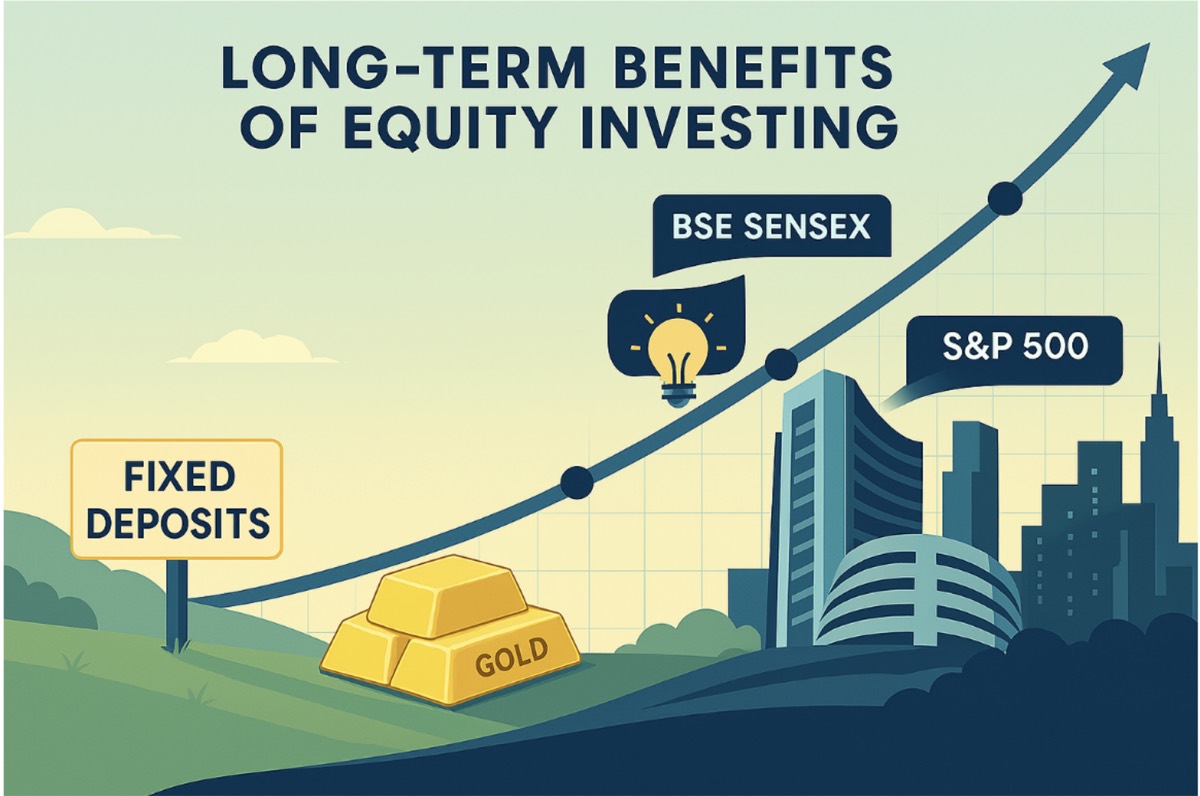
Equity investments have historically been effective for generating long-term wealth. Despite market volatility and economic challenges, historical data demonstrates the tendency of equity markets to recover, rewarding patient investors. Over time, both Indian and US equity markets have delivered impressive returns, significantly outpacing traditional investment options like fixed deposits, gold, and real estate. This article will examine historical returns and discuss the advantages of investing in equities.
Historical Performance: India vs. USA vs. Gold
To analyze the historical effectiveness of equity investments in India and the USA compared to gold, we will examine the Total Return Index (TRI) for representative market indices in each country. The TRI provides a comprehensive view of investment returns, considering both capital growth and dividend payouts.
| Country | Index | Historical Returns: 1980-2024 | Value of 1 lac invested in 1980 |
|---|---|---|---|
| India | BSE Sensex (30 large-cap stocks) | 15.79% | ₹6.33 Crore |
| USA | S&P 500 (500 large-cap stocks) | 11.99% | ₹1.46 Crore |
| Global | Gold | 9.82% | ₹0.68 Crore |
*Historical index returns, data to 2024.*
The above table shows that equity has significantly outperformed gold, even considering gold's recent strong performance. The difference is stark: a ₹1 lakh investment in the BSE Sensex in 1980 would have resulted in approximately ₹5.6 crore more in returns compared to gold.
Why Stocks Often Grow Faster Than the Economy
Stocks tend to deliver better long-term returns than the overall economy because they focus on the strongest, most profitable companies. Think of it this way:
- Picking the Winners:
- Economic growth includes all sectors, even those that grow slowly.
- Stocks, however, are tied to companies that are performing really well. These companies usually have smart leaders, generate innovative ideas, and use their money wisely.
- These successful companies often reinvest their profits to fuel further growth, thereby increasing their value.
- Growth on Growth:
- This focus on high-growth companies allows for a "compounding effect," where gains accumulate and often surpass the average rate of economic growth.
An Example to Illustrate:
Imagine a country's economy grows by 6.5% after adjusting for inflation, and inflation itself is 5%. If you add those together, the economy is growing by about 11.5% overall.
- However, that 11.5% includes slow-growing areas like farming.
- The fastest-growing parts of the economy, like technology or innovative services, might be growing even faster.
- Companies in which you invest through the stock market are typically in these fast-growing areas.
- This is one structural reason equity markets have historically grown faster than the broader economy over time.
In Essence:
Investing in stocks means selecting the top performers. Consequently, because these top performers grow at a faster rate than the average company, your stock investments have historically tended to grow faster than the overall economy over the long run. This "Selective Growth Advantage" is one reason cited for equities' historical performance, though it is not a guarantee of future results.Why Invest in Equities?
Investing in equities offers long-term financial growth and stability. Here are four compelling reasons to invest in equities:
1. Better Long-Term Returns
Equities have historically outperformed other asset classes like fixed deposits or gold. Over decades, stock markets have delivered inflation-beating returns, enabling investors to build substantial wealth. While short-term volatility exists, staying invested for the long run allows compounding to amplify earnings and maximize gains.
2. Beating Inflation
Inflation erodes purchasing power, reducing the real value of savings. Equity investments have historically grown faster than inflation over long periods, helping money retain its worth over time. Unlike fixed-income instruments with low yields, companies continuously expand, innovate, and increase profits, translating into higher stock prices and better returns for investors.
3. Liquidity & Flexibility
Equity markets offer high liquidity, allowing investors to buy and sell stocks anytime. This flexibility makes equities more accessible than real estate or long-term bonds, where selling assets can be complicated. Investors can adjust their portfolios based on market conditions, risk appetite, and financial goals.
4. Diversification & Risk Management
Equities offer diversification benefits across industries, sectors, and geographies. Investors can distribute risk by holding a balanced mix of stocks, reducing exposure to market downturns in a single sector. ETFs and index funds further enhance diversification, which has historically been associated with lower volatility.
Conclusion
Equity investing has historically been an effective strategy for building long-term wealth. Historical data indicates that equities outperform traditional asset classes such as gold, fixed deposits, and real estate by providing inflation-adjusted returns. The BSE Sensex TRI’s approximate 15.79% CAGR (1980–2024) underscores the power of compounding and the growth potential of leading companies. Although equities experience short-term volatility, staying invested for the long term is how many investors aim to work toward their financial goals.