
Your SIP Will Feel Like Nothing Is Happening for the First Few Years. That Is Normal. Here Is Why.

A friend starts a SIP. Every month, a fixed amount goes out of their account and gets invested. After one year, they open the app. They expect to see nice growth. But the amount looks almost the same as what they put in. On a bad month, it even looks a little less.
They feel let down. "Everyone talks about compounding. So where is it?" And they stop the SIP.
That is the biggest and most costly mistake a new investor can make. But it is easy to see why they made it. Nobody told them how compounding really works. So let us make it simple.
What is a SIP?
A SIP just means this: you invest a fixed amount, on a fixed date, every month. And it happens automatically.
You choose the amount. You choose the date. After that, you do nothing. The money gets invested on its own.
No guessing. No watching the market. No thinking "should I invest today or wait?" You decide once, and it keeps running.
The real power of a SIP is simple. It takes you out of the process. Your fear, your mood, your urge to wait for the "right time" — all of that is removed. And for most people, that is a very good thing.
What is compounding?
Compounding has a big name but a simple meaning: your returns start earning returns too.
Year 1: your money earns a little. Year 2: you earn on your money and on last year's gains. Year 3: you earn on all of it together.
Every year, the amount you are growing gets bigger. So the growth gets bigger too.
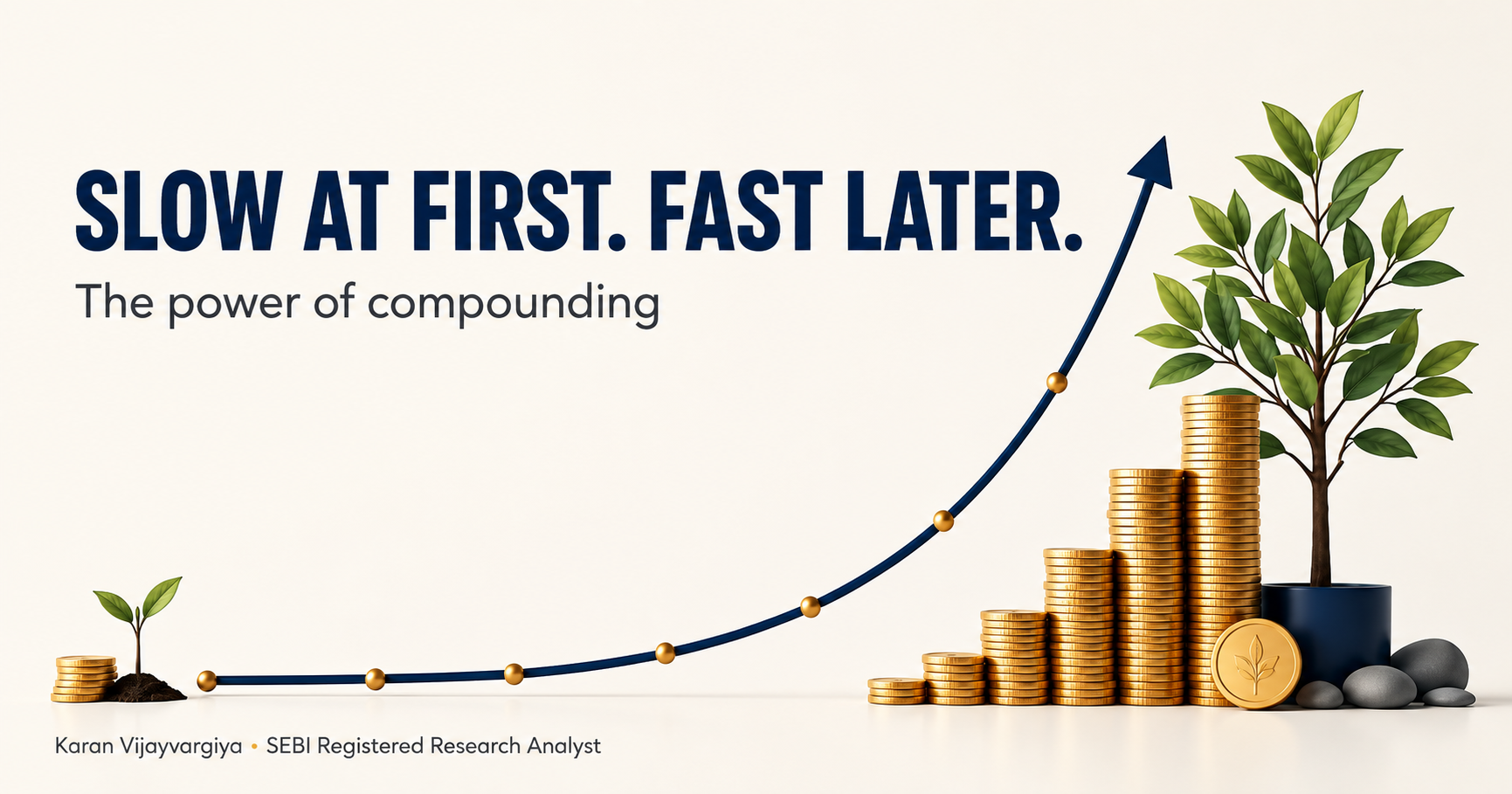
Here is the part nobody tells you. Compounding is slow at the start and fast later. Slower than you expect in the beginning. Faster than you expect at the end.
If you drew it as a line, it would look almost flat for years. Then it would suddenly shoot up.
That slow start is not a problem. That is just how it works. The engine is running the whole time. You just cannot see much yet, because your money is still small.
Why the early years feel empty
Go back to that friend. In year 1, there is very little money saved up. So the returns are small. So the total barely moves.
This does not mean the plan is broken. It just means it is early.
Most of the real growth comes in the later years. But most beginners never reach those years, because they quit during the slow start.
The people who win at this are not the smartest. They are simply the ones who did not quit early.
So remember this: the boring early years are not a punishment. They are the entry ticket to the fast-growth years.
A surprise: a falling market can help your SIP
This part feels strange, but it is true.
When you invest the same amount every month, your money buys more units when prices are low, and fewer units when prices are high. You are not doing anything clever. The fixed amount does it for you.
This is called rupee cost averaging.
So a falling market is not your enemy while you are still investing. It is like a sale. Your monthly money buys more units at lower prices. When the market goes up again later, that can work in your favour.
So the thing that scares people into stopping — a falling market — is often the thing a long-term SIP quietly likes.
Stopping your SIP when the market falls is like leaving a shop the moment everything goes on sale.
The two big mistakes
Almost every failed SIP fails for one of these two reasons:
- Quitting early, because "nothing is happening." You leave during the slow start and never reach the fast part. Time matters more than a big amount.
- Stopping when the market falls, exactly when your money would buy the most units at the cheapest prices. Fear says stop. The maths says keep going.
Both mistakes come from the same habit: reacting to the short term while running a long-term plan.
The one skill that makes a SIP work is simple. Stay calm, and let it run.
What should you actually do?
Very little. That is the point.
- Set it up and forget it. Same amount, same date, automatic. The less you touch it, the better.
- Do not check it every week. Checking too often makes you want to interfere. Here, doing less usually gives a better result.
- Keep going when the market falls. Especially then.
- Raise the amount as your income grows. A small yearly increase adds up to a lot over time.
How this connects to real wealth
The same idea — patience, discipline, and giving it time — is the base of all good investing.
A SIP is one way to do it. Buying good companies and holding them for years is another. Both are the same thing: let time do the work, and do not disturb it.
When you are ready to build this with researched, quality stock ideas instead of guessing, this is the order I follow in my research:
Step 1 — Equity Growth & Wealth Pack. My monthly research reports with quality stock ideas for long-term wealth. This is where you start. https://karanvijayvargiya.raacord.com/sub/681bde
Step 2 — Tactical Growth Pack (Positional). The next step — positional ideas held for weeks to months, only after your long-term base is ready. https://karanvijayvargiya.raacord.com/sub/83932e
Step 3 — Momentum Edge Pack (Swing Trading). The most active step — swing trades held for days to weeks, a small part of your money, only after the first two are set. https://ra.karanvijayvargiya.com/sub/56552e
You can learn more about me at www.karanvijayvargiya.com.
The hardest part of compounding is not understanding it. It is waiting for it. If you can stay calm through a few slow years — and even smile through the scary ones — you have already learned the most valuable skill in investing.
Karan Vijayvargiya is a SEBI Registered Research Analyst (Registration No. INH000025470 | BSE Enlistment No. 7030), based in Indore, holding an MBA and NISM Series XV (Research Analyst) certification.
This article is for investor education only. It is not investment advice and does not recommend buying or selling any security or scheme. Registration granted by SEBI and certification from NISM in no way guarantee the performance of the analyst or provide any assurance of returns. Investments in the securities market, including SIPs, are subject to market risks; returns are not guaranteed and past performance is not indicative of future results. Read all related documents carefully before investing.