
India EV Sector 2026: Complete Analysis – Opportunity, Value Chain, Risks & Where Real Money Lies

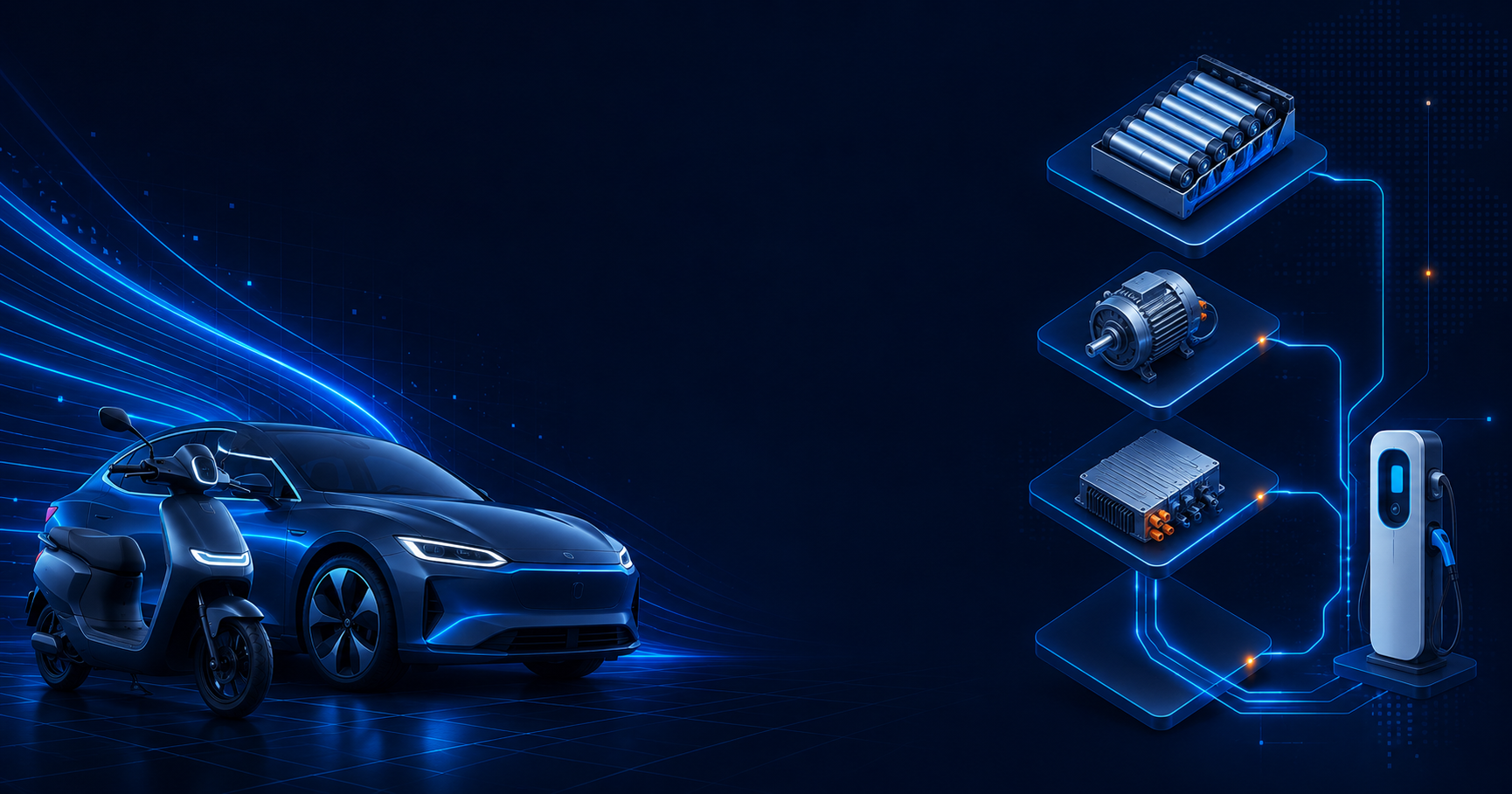
India EV Sector 2026: The Real Opportunity Is Not Just in Cars
India’s electric vehicle story has moved beyond the early hype phase. In 2026, the sector is no longer just about “EV adoption.” It is about value chain control, localisation depth, and who captures the margins.
After deep research across products, components, policy, infrastructure, battery technology, economics, supply chain, and consumer behaviour, one clear pattern emerges:
The real long-term value is shifting from vehicle assembly to the layers underneath.
1. EV Product Categories in India
India’s EV market is multi-layered:
- Electric Two-Wheelers (E2W) – Highest volume
- Electric Three-Wheelers (E3W) – Highest penetration
- Passenger Electric Cars
- Electric Buses
- Commercial / Cargo vehicles
Among these, 2W and 3W currently drive the majority of volumes, while passenger cars are growing but still face mass-market hurdles.
2. The Most Critical Product: Battery
Without the battery, the EV sector does not exist.
It typically accounts for 30–45% of the vehicle cost and remains the single most important component.
Key points:
- LFP chemistry is currently dominant in mass-market and commercial segments
- Cell manufacturing in India is still limited despite PLI schemes
- Most cells continue to be imported
- Battery life, degradation, and residual value remain major consumer concerns
3. Where Value Is Actually Shifting
Vehicle assembly gets the attention.
But the more attractive long-term segments are:
- Power Electronics & Controllers
- Traction Motors / e-Drive units
- BMS + Intelligent Battery Packs
- Charging Hardware + Smart Software
Companies moving from pure assembly toward design + manufacturing are better positioned for durable margins.
4. Key Challenges Still Holding Back Mass Adoption
Even as sales grow, several trust and structural issues remain:
- Residual value uncertainty
- Charging reliability perception
- Service network confidence
- Battery health transparency
- Apartment charging access
Price is no longer the only barrier. Trust and residual value fear are equally important.
5. Competitive Landscape Snapshot (2026)
- 2W: TVS leading, followed by Bajaj and Ather
- 3W: Mahindra Last Mile dominant
- Passenger Cars: Tata still leads, Mahindra closing the gap, MG strong
- Indian OEMs currently control volume, while Chinese/JV players are stronger in technology-heavy segments
6. Export & Circular Economy Angle
India has meaningful export potential in electric 2W and 3W because of cost advantage and existing ICE export networks.
On the battery side, second-life applications (solar storage, telecom backup, BESS) will become important from 2027–28 as the first wave of EV batteries retire.
Final Takeaway
India’s EV sector is real and growing.
But the easy phase of “just buy any EV story” is over.
The next phase will reward those who understand:
- Difference between assembly and deep manufacturing
- Critical component opportunities
- Supply chain risks
- Consumer trust barriers
- Long-term economics (TCO + residual value)
SEBI Disclaimer / Important Disclosure
This article is for educational and informational purposes only.
It does not constitute investment advice, stock recommendation, or an offer to buy/sell any securities.\
Karan Vijayvargiya is a SEBI Registered Research Analyst.
All investment decisions should be made after independent research, risk assessment, and consultation with a qualified financial advisor if required.
Past performance is not indicative of future results.
Investments in securities market are subject to market risks. Read all related documents carefully before investing.
The subscription products mentioned above are research/advisory services. Please read the terms, risk disclosures, and disclaimers on the respective pages before subscribing.