
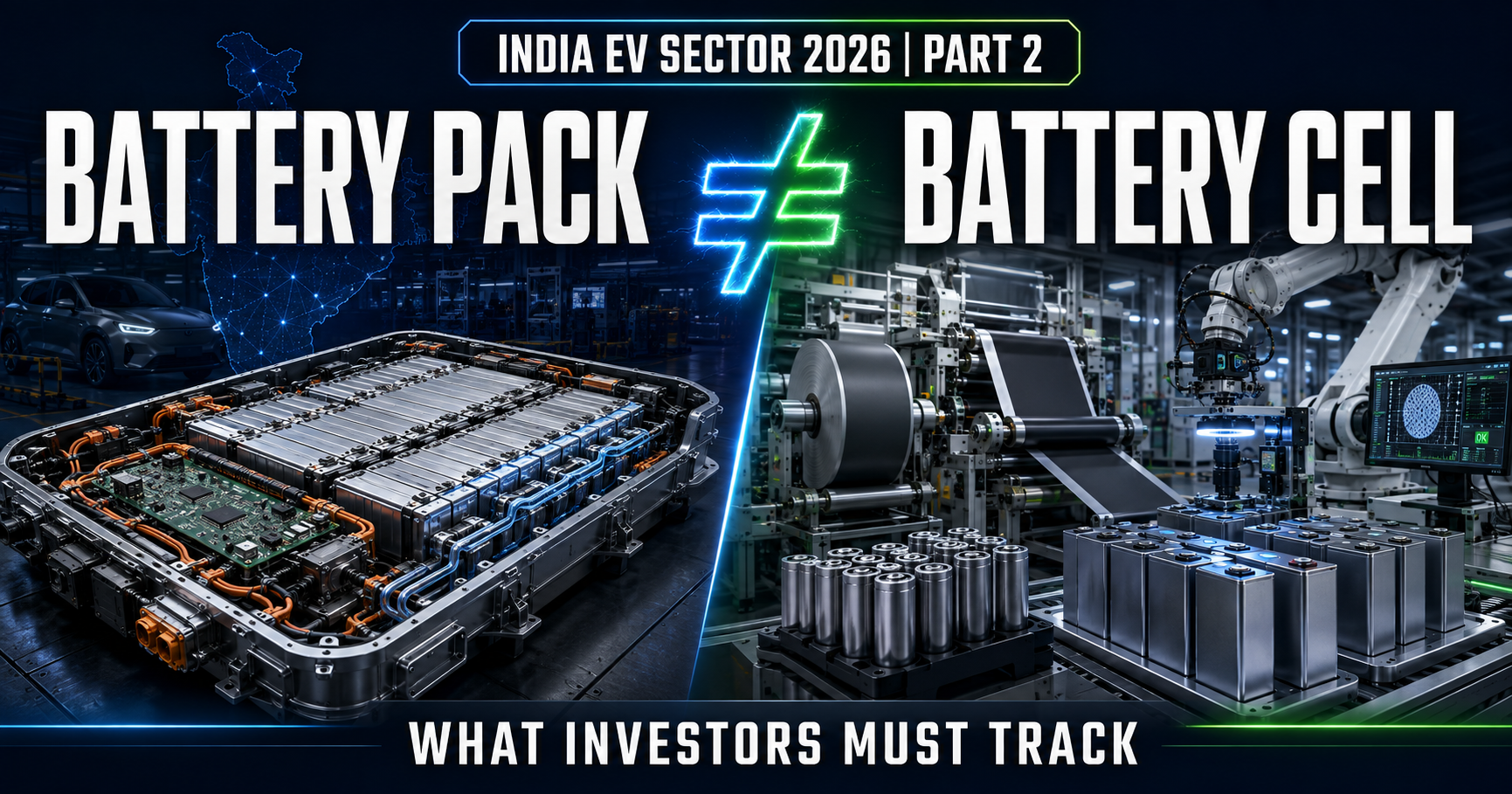
India EV Sector 2026 — Part 2: A Battery Pack Factory Is Not a Battery Cell Factory

KARAN VIJAYVARGIYA | SEBI Registration No.: INH000025470
Series navigation: Read Part 1 — India EV Sector 2026: Complete Analysis
In Part 1, we discussed why the real EV opportunity is moving below vehicle assembly and into batteries, power electronics, motors, charging and software.
The next question is simple but important:
When a company says it manufactures EV batteries, what does it actually manufacture?
A battery pack factory and a battery cell factory may both be presented as “battery manufacturing”. But they are not the same business.
Their technology, capital requirements, supply chains and execution risks are very different.
Understanding this difference is essential before analysing any battery-manufacturing story.
1. First Understand the Battery Structure
An EV battery can be viewed in layers:
Raw materials → Active materials → Electrodes → Cells → Modules → Battery pack → Vehicle
Some modern designs remove the module layer and place cells directly into the pack. However, the basic distinction remains:
- The cell stores electrical energy through an electrochemical reaction.
- The pack combines and manages multiple cells so they can safely power a vehicle.
A company can manufacture a sophisticated battery pack without manufacturing the cells inside it.
2. What Happens Inside a Battery Cell Factory?
A cell factory manufactures the electrochemical unit at the heart of the battery.
The broad process includes:
- Mixing active materials to prepare electrode slurry
- Coating the slurry onto metal foils
- Drying, pressing and cutting the electrodes
- Stacking or winding the cathode, separator and anode
- Filling the cell with electrolyte
- Sealing the cell
- Formation charging, ageing, grading and testing
This is precision manufacturing.
Small variations in coating quality, moisture, contamination, temperature or material consistency can affect safety, battery life and performance.
The difficult part is not producing a few working cells. The difficult part is producing millions of consistent, automotive-qualified cells at a competitive cost.
This makes four operating factors extremely important:
- Yield: How much production is saleable?
- Utilisation: How much of installed capacity is actually being used?
- Quality consistency: Do cells perform uniformly across batches?
- Customer qualification: Have vehicle manufacturers approved the cells for commercial use?
The IEA notes that building nameplate capacity is only the first step. New battery facilities can take years to approach nominal output, while competitive production requires high yields and automation.
Therefore:
Installed GWh is not the same as saleable GWh.
3. What Happens Inside a Battery Pack Factory?
A pack manufacturer generally starts with finished cells sourced from a cell supplier.
It then integrates them with:
- Battery Management System (BMS)
- Cell monitoring and balancing electronics
- Busbars, wiring, contactors, fuses and electrical protection
- Cooling or thermal-management systems
- Sensors
- Mechanical enclosure and crash protection
- Software and vehicle communication
The pack is then tested for safety, vibration, temperature, water and dust protection, electrical performance and vehicle compatibility.
This is not automatically a low-value assembly activity.
A well-designed pack can create differentiation through:
- Better thermal control
- More accurate battery-health estimation
- Improved safety
- Longer usable battery life
- Efficient packaging
- Lower weight
- Faster charging without excessive degradation
- Better integration with the vehicle
The BMS is especially important. It monitors the cells, controls charging and discharging, manages safety events and helps estimate the battery’s state of charge and state of health.
However, pack manufacturing still does not provide control over the chemistry and manufacturing quality of the cell itself.
4. Pack Manufacturing vs Cell Manufacturing
Battery pack business
- Usually requires lower capital investment than cell manufacturing
- Can reach commercial production faster
- Depends on external cell suppliers
- Can differentiate through BMS, software, thermal design and integration
- Faces warranty, safety and customer-concentration risks
- May face pricing pressure if it performs only basic assembly
Battery cell business
- Requires much higher capital investment and technical capability
- Needs tight process and quality control
- Takes longer to stabilise and qualify
- Provides deeper control over technology and supply
- Faces raw-material, yield, utilisation and technology-obsolescence risks
- Can destroy capital if the plant operates below an economic scale
The cell business may offer deeper manufacturing control. But deeper manufacturing does not automatically mean better returns.
The outcome depends on execution.
5. Why Localisation Must Be Measured Layer by Layer
A battery pack assembled in India may still use imported cells.
A cell manufactured in India may still depend on imported:
- Cathode active material
- Anode active material
- Separator
- Electrolyte and additives
- Manufacturing equipment
- Process technology
Therefore, “Made in India” should not be treated as a simple yes-or-no label.
Localisation must be examined across the complete chain:
Materials → Electrodes → Cells → Packs → Vehicles
This matters because the global battery supply chain remains highly concentrated. According to the IEA, China produced more than 80% of global battery cells in 2025 and held even larger shares in key cathode and anode active materials.
India’s ACC Production Linked Incentive scheme is designed to build domestic cell-manufacturing capability. The scheme has an outlay of ₹18,100 crore and requires beneficiary firms to achieve at least 25% domestic value addition, increasing to 60% within five years.
But a policy target or project announcement is not evidence that localisation has already been achieved.
Investors must track actual production and value addition.
6. Announced Capacity Can Create the Wrong Picture
Battery projects are often presented using GWh of planned capacity.
That number is useful, but incomplete.
Before treating announced capacity as an operating asset, ask:
- Has land been acquired?
- Has financing been secured?
- Has equipment been ordered and installed?
- Has trial production started?
- What is the current production yield?
- Has the product passed customer qualification?
- Is commercial production running?
- What is the actual utilisation rate?
- Is the output supported by firm customer demand?
The journey is:
Announced → Funded → Constructed → Commissioned → Qualified → Commercially utilised
Each step carries different risks.
A press release usually describes the first step. Business value is created near the end of the chain.
7. The Economics Investors Should Track
For a battery pack manufacturer, focus on:
- Value added beyond cell procurement
- BMS and software ownership
- Customer concentration
- Warranty and replacement costs
- Pack-level safety record
- Ability to source cells at competitive prices
- Revenue and margins per pack
- Working-capital requirements
For a battery cell manufacturer, focus on:
- Capital expenditure per GWh
- Production yield and scrap rate
- Capacity utilisation
- Cost per kWh
- Energy and material costs
- Customer qualification timelines
- Long-term purchase commitments
- Dependence on incentives
- Cash generation after capital expenditure
Do not analyse either business only through revenue growth.
Battery manufacturing can show rapid revenue growth while consuming large amounts of cash.
8. Five Statements Investors Should Not Treat as Equal
- “We have announced a battery plant.”
- “The plant has been commissioned.”
- “Trial production has started.”
- “Customers have qualified the product.”
- “The plant is producing profitably at a healthy utilisation rate.”
These statements represent completely different stages of execution.
The same applies to localisation:
- Domestic pack does not necessarily mean domestic cell.
- Domestic cell does not necessarily mean domestic materials.
- Customer qualification does not necessarily mean high utilisation.
- High utilisation does not necessarily mean positive free cash flow.
Final Takeaway
Battery manufacturing is not one single business.
Pack manufacturing and cell manufacturing create value in different ways and carry different risks.
A differentiated pack manufacturer with strong BMS capability, safety engineering and customer integration may create more value than a poorly utilised cell factory.
At the same time, a cell manufacturer that achieves high yield, customer qualification, cost competitiveness and upstream localisation can build a much deeper strategic advantage.
The label does not decide the quality of the business.
Execution does.
Do not track only announced GWh. Track qualified output, utilisation, localisation and cash generation.
Previous Article
Sources
- International Energy Agency, Global EV Outlook 2026 — Electric Vehicle Batteries:
- International Energy Agency, Global EV Outlook 2026 — Manufacturing and Trade:
- Ministry of Heavy Industries, PLI Scheme for Advanced Chemistry Cell Battery Storage:
- VDMA, Battery Production — Process Chain:
- US Department of Energy, Lithium-ion Cell Manufacturing and Pack Integration Process:
- Bosch Mobility, Battery Management System and Battery Disconnect Unit:
SEBI Disclaimer / Important Disclosure
This article discusses sector-level manufacturing and is for educational and informational purposes only. No listed security is being analysed or recommended.
It does not constitute personalised investment advice, a stock recommendation, or an offer or solicitation to buy, sell or hold any security. Information is based on publicly available sources as of the date of publication and may change. Readers should independently verify the information and consider their objectives, risk profile and financial circumstances before acting.
KARAN VIJAYVARGIYA is a SEBI Registered Research Analyst. SEBI Registration No.: INH000025470.
Past performance is not indicative of future results.
Investment in securities market are subject to market risks. Read all the related documents carefully before investing.
Registration granted by SEBI and certification from NISM in no way guarantee performance of the intermediary or provide any assurance of returns to investors.