
Is Gautam Adani Building an Empire That Could Control India's Trade?

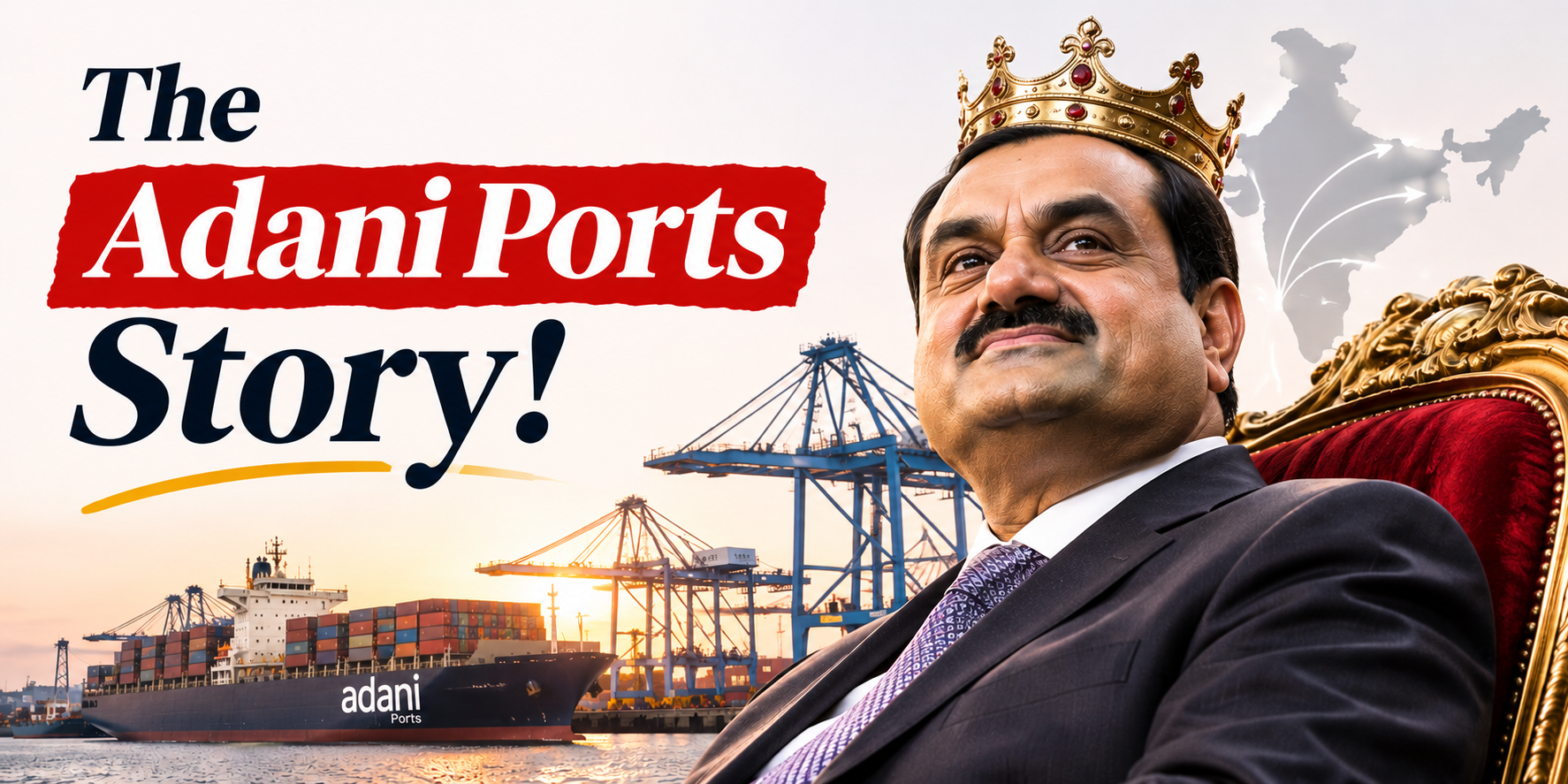
The jetty that became a giant
In 1994, the Gujarat Maritime Board approved a small captive jetty at Mundra, on the Kutch coast. Today that jetty sits at the heart of Adani Ports and SEZ (APSEZ), which handled 500.8 million tonnes of cargo in FY26.
Here is the number that made me sit up. APSEZ's Indian ports handle about 27% of all of India's cargo and about 45% of its containers. Roughly every fourth tonne that enters or leaves India by sea passes through one of their ports.
I spent the last few weeks reading annual results, investor presentations and the latest earnings calls. This is the highlights package of everything I found, so think of it as the post match show, not the five day Test.
One promise before we start: no price targets and no buy or sell calls. This is about understanding the business.
How a port actually makes money
Picture a container of phones travelling from China to an importer in Delhi. Through Mundra, it makes six stops. Tugs guide the ship to the berth, giant cranes lift the box off, and it waits in the yard for customs. Then a train or truck carries it to an inland depot, a warehouse handles it, and finally the importer gets the goods.
Every stop is a cash counter. The ship operator pays one bill for port dues, pilotage and towage. The cargo owner pays a second bill for handling, wharfage and storage. It is like a Karan Johar wedding, where the caterer, the band and the decorator all get paid, and the bride's father (here, the importer) ends up paying for everything.
Not all cargo pays the same. Export and import containers earn the most per tonne, liquids like crude and LNG come next, and coal and iron ore earn much less. APSEZ does not disclose revenue by cargo type, so treat this ranking as directional.
One more thing: capacity is not cargo. APSEZ had 653 million tonnes of capacity at March 2026, but its Indian ports handled about 451 million tonnes in FY26. Building a stadium for 50,000 people does not mean 50,000 people turn up every day.
Mundra, the Dhoni of the team
The real star is the domestic ports business. In Q2 FY27 (July to September 2026), it earned ₹7,177 crore of revenue at a 72.5% EBITDA margin. That is 63% of group revenue but 76% of group EBITDA.
Why such fat margins? Because the expensive part is already built. Breakwaters, dredging and berths are paid for once, and after that every extra tonne is cheap to handle. It works like a single screen cinema: once the hall and projector are paid for, every extra ticket is almost pure profit.
The biggest hall of all is Mundra. It has about 274 million tonnes of capacity, handled 105 million tonnes in H1 FY27 (45% of APSEZ's domestic volume) and earned a 72% margin in Q2. Its return on capital went from 20% in FY23 to 40% in FY26. Mundra is the MS Dhoni of this side: calm, consistent and the reason the scoreboard looks good. It is the closest deep water port to north India, it sits on the Western Dedicated Freight Corridor, and it has its own 12,500 hectare SEZ.
One honest note. Domestic revenue grew 13% in FY26 while cargo grew only about 5%. Price increases, a richer cargo mix and some one off charges did a lot of the batting, and part of that may not repeat.
Beyond the boundary: logistics, marine and overseas ports
APSEZ wants to keep earning after the container leaves the port. So it runs 132 rail rakes, 12 logistics parks, 3.1 million square feet of warehousing and about 937 trucks. Logistics revenue was ₹4,478 crore in FY26, up 55%.
The catch is the margin: about 15% to 20%, against about 73% at the ports. So why bother? Because it keeps customers loyal. Once your ship, train and warehouse all sit with one company, switching ports is like Raju walking out on Shyam and Baburao in Hera Pheri. Technically possible, practically never happening.
Marine is the other side hustle. It runs 138 vessels, mostly on take or pay contracts, and earned ₹1,357 crore of EBITDA in FY26. Its normal margin is about 55%, but that fell to 44.4% in Q2 FY27 because 7 to 8 contracted vessels could not pass through the Strait of Hormuz.
Then come four overseas ports: NQXT in Australia, a terminal in Colombo, Haifa in Israel and a stake in Dar es Salaam. International EBITDA was ₹878 crore in Q2 FY27, up 236%. Much of that jump came from buying NQXT, so it is more like signing a star at the auction than developing one in the academy.
The growth triggers, and the required run rate
Management's plan is called Ambition 2031. It targets ₹91,500 crore of revenue and ₹52,000 crore of EBITDA by FY31, about 2.3 times FY26 EBITDA. These are management targets, not forecasts. Here are the seven triggers behind them, with what each does to revenue (top line) and profit (bottom line).
- Domestic capacity goes from 653 to 1,000 million tonnes by December 2030. At Q2 FY27 numbers, every extra 10 million tonnes adds about ₹610 crore of revenue and ₹440 crore of EBITDA (my illustrative maths). The bill is ₹60,000 to 63,000 crore of capex, which brings more depreciation and interest.
- Pricing and mix let revenue grow faster than cargo. Most of a price hike drops straight into profit, but the one off parts will not repeat.
- International ports add hard currency revenue at a 47.7% margin, along with more debt.
- Vizhinjam, India's first deep water transshipment port, could win back cargo that is now transferred in Colombo or Singapore. MSC agreed to buy 49% of it for US$1.397 billion, but approvals were still pending in late October 2026.
- Logistics targets ₹19,500 crore of revenue by FY31, yet that is only about 6% of FY31 EBITDA. Revenue grows much faster than profit here.
- Marine grows by adding vessels on contracts at about a 55% normal margin.
- Acquisitions are possible because net debt is just 1.8 times EBITDA, and about 20 overseas assets are being studied. The return depends entirely on the price paid.
Now the cricket maths. To reach 850 million tonnes of domestic cargo by FY31, APSEZ needs about 13% to 14% volume growth every year. In H1 FY27 it managed about 2% to 4%. The required run rate is well above the current run rate, and every fan knows how that chase feels.
The post match press conferences
Earnings calls are like post match press conferences. Everyone sounds confident, so the trick is to listen for what changes.
On the Q1 FY27 call (29 July 2026), revenue and EBITDA grew 19%, but domestic cargo grew only 2%. Container rail volume fell 19% because tile exports from Morbi weakened during the West Asia crisis. The CEO said that if the company did nothing, net debt to EBITDA would be close to zero in five years. Management also argued that NQXT's 17 times EBITDA price was really 13 to 14 times after adjustments, which is their view and not something I could verify.
On the Q2 FY27 call (28 October 2026), revenue rose 24% to ₹11,340 crore and EBITDA rose 23% to ₹6,807 crore. FY27 revenue and EBITDA guidance each went up by ₹1,000 crore, while capex guidance went up by ₹3,000 crore. Domestic cargo grew about 4% in the quarter, though the CEO said volume was growing at double digits by the date of the call.
The track record is a Sehwag innings. Revenue and EBITDA guidance was met or beaten every year from FY23 to FY26, but volume guidance was missed in three of those four years, and capex came in above guidance in three of four. Great numbers on the board, but you keep an eye on the risky shots.
The risks, or the Lagaan question
A port concession works a bit like Lagaan. The state lets you use the land and the waterfront for a fixed period, and you pay your share along the way. Mundra's concession from the Gujarat Maritime Board ends on 16 February 2031, and Mundra made up about 24% of group EBITDA in H1 FY27. APSEZ applied for extensions in 2015 and 2021, and in April 2026 the CEO said the talks are positive but the timing is not in their hands. The concession terms are not public, so nobody outside can tell what an extension might cost.
The other risks worth watching:
- Domestic market share slipped from 28.1% to 27.3% of India's cargo, and from 45.9% to 44.4% of its containers.
- The capex plan is ₹90,000 to 100,000 crore over five years, and capex has run above guidance before.
- Geopolitics matters, from the Strait of Hormuz to Haifa.
- Competition is coming, especially the new Vadhavan port near Mumbai, which targets its first operations around 2028 to 2029.
- Governance deserves attention, because NQXT was bought from a promoter related company and paid for in APSEZ shares.
The final scorecard
So what did I learn?
Domestic ports are the profit engine, and their moat is location plus assets that are very hard to copy. Right now, growth leans more on pricing, acquisitions and new assets than on cargo volume. And the Mundra concession will shape a big part of the long term story.
If you want to follow this the way a fan follows a series, track five numbers every quarter: domestic cargo growth versus India, market share, the domestic margin (72.5% in Q2 FY27), the international margin (47.7% in Q2 FY27), and net debt to EBITDA alongside capex versus guidance.
I'm also putting out a full video breakdown on YouTube. Tell me which trigger you think matters most, because I would love to argue about it.
All data is as of 31 October 2026. This is educational content, not investment advice.
SEBI Registration No.: INH000026053.